
- INTRODUCTION
- WHY BLUETOOTH 5.0 IS THE SILENT POWERHOUSE OF SMART HOMES
- MESH MAGIC — HOW BLUETOOTH MESH LIGHTS UP EVERY CORNER OF YOUR HOME
- PERFORMANCE THAT MATTERS — RANGE, SPEED, AND LOW ENERGY IN REAL HOMES
- BLUETOOTH 5.0 VS WI-FI, ZIGBEE & THREAD — WHICH ONE WINS FOR SMART HOMES?
- SECURITY AND RELIABILITY YOU CAN TRUST
- PRACTICAL DEPLOYMENT — BRINGING BLUETOOTH 5.0 INTO YOUR HOME
- THE FUTURE OF SMART LIVING WITH BLUETOOTH 5.0
- REAL PRODUCTS TO START WITH (SPECIFIC MODELS & AMAZON PLACEHOLDERS)
- FAQs
- CONCLUSION
INTRODUCTION
Smart homes should feel effortless — the kind of place where technology quietly fades into the background and life flows. Increasingly, that experience depends on smarter local radios rather than on distant cloud services.
Bluetooth 5.0 is one of those quietly transformative upgrades: longer range, faster small-data bursts, and richer advertising that together make presence detection, battery-powered sensors, and whole-home lighting far more practical and less fiddly than before.
If you’ve ever been upset by a motion sensor that stops working after a few months, a bulb that disconnects from the network, or smart home features that don’t work smoothly unless you’re connected to the cloud, Bluetooth 5.0 provides a real solution. Pair it with Bluetooth mesh lighting control, and the benefits scale from a single room to an entire house: commands ripple locally, networks self-heal around failed nodes, and presence-based automations become far more nuanced and reliable. This is not about replacing Wi-Fi or other protocols; it’s about using the right tool for the right job so your home behaves like a single, coherent system rather than a pile of apps and passwords.
This article walks you through what Bluetooth 5.0 actually does for everyday homes, explains how Bluetooth mesh lighting control solves common reliability headaches, compares Bluetooth to Wi-Fi, Zigbee, and Thread, and gives concrete planning and deployment tips you can use right now.
Expect real-world tradeoffs, hands-on examples, and product models so you can evaluate gear immediately. The goal here is not to overload you with specs — it’s to give you practical guidance that turns confusion into confidence, so your next smart-home upgrade feels like progress, not a project.
WHY BLUETOOTH 5.0 IS THE SILENT POWERHOUSE OF SMART HOMES
Most people still associate Bluetooth with earbuds or car pairing. Still, Bluetooth 5.0 is a different animal — and it changes how connected home devices behave in three important ways: range, speed, and broadcasting capacity. Those specs matter because they directly affect reliability, battery life, and the intelligence of proximity-driven automations.
Range: Bluetooth 5.0 introduced coded PHY modes that allow devices to trade throughput for reach. In practical terms, this reduces dead zones: backyard moisture sensors, gate sensors, and devices in detached garages are more likely to talk reliably to indoor hubs without dedicated repeaters. That’s a meaningful savings in hardware and a huge reduction in complexity.
Speed: The 2 Mbps LE option halves the time some small transfers take. You won’t stream video over BLE, but pairing, firmware updates (DFU), and short control packets are noticeably quicker. Less waiting, fewer failed updates, and more immediate responses when you press a button or trigger a scene.
Broadcasting capacity: Advertising packets can carry a much richer context. Beacons can include more states, so presence-driven automations are less binary and more nuanced — recognizing “arrived home” vs “passed by the house” with better fidelity.
Why this matters: homeowners stop caring about specs when devices behave. A door sensor that runs for years on a coin cell and reliably reports state is loved; one that dies or drops connection is abandoned. Bluetooth 5.0 improves the odds that devices integrate quietly into daily life — it complements Wi-Fi and other protocols rather than trying to replace them.
MESH MAGIC — HOW BLUETOOTH MESH LIGHTS UP EVERY CORNER OF YOUR HOME
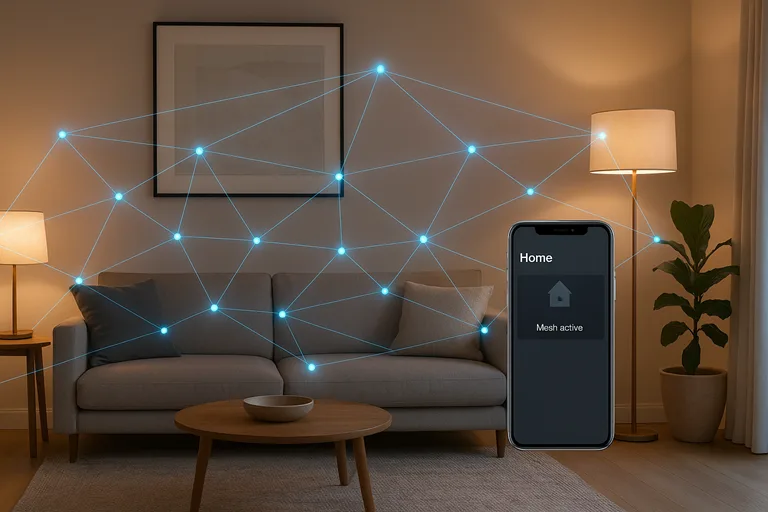
Bluetooth 5.0 becomes especially useful when paired with Bluetooth Mesh. Mesh is a decentralized network topology where capable nodes relay messages for one another. In plain terms, devices act as messengers for nearby neighbors, so your system keeps working even when a single node fails.
Imagine a hallway of people passing a note. If one person steps away, someone else picks up the note, and the message still travels across the room.
That’s mesh: self-healing and distributed. For lighting control, this is transformative. A single “movie mode” command can ripple through dozens of bulbs without each needing direct line-of-sight to a central hub or to your router—no cloud round-trip required.
Why installers like it: mesh reduces complaints about bulbs “dropping off” and improves responsiveness for entire scenes. Compared to Wi-Fi bulbs, mesh often offers lower latency and doesn’t depend on a healthy internet connection. Compared to Zigbee or Thread, Bluetooth’s strong practical advantage is ubiquity — most phones, tablets, and many modules already support BLE, which makes pairing and diagnostics less awkward for homeowners.
Practical deployment tip: ensure a backbone of always-on relay devices. Mains-powered ceiling lights and smart speakers make excellent relays because they’re always powered and often centrally located. With a robust backbone, the mesh routes intelligently, provides redundancy, and keeps automations local and private.
A quick real-life benefit: in a properly planned mesh, pressing a wall switch dims dozens of bulbs instantly and consistently — no lag, no flicker, no “one room lags” problems. That quality of response is what makes mesh feel not just clever, but dependable.
PERFORMANCE THAT MATTERS — RANGE, SPEED, AND LOW ENERGY IN REAL HOMES
Specs only matter when they solve everyday headaches. Bluetooth 5.0’s improvements — in range, speed, and energy consumption — translate into fewer repeaters, faster maintenance, and devices that remain useful for years.
Long-range mode in action: Bluetooth 5.0’s coded PHY (the long-range modes) lets devices favor robustness over throughput. Practically, this means sensors in garages, gates, or gardens can reach an indoor hub without a dedicated repeater. That eliminates extra hardware and simplifies installs.
Important caveat: building materials matter. Metal studs, concrete, and heavy insulation reduce RF; place relay-capable nodes high and central (ceiling lights are ideal) to maximize coverage.
Speed boosts where you notice them: 2 Mbps BLE speeds up many small tasks. Firmware updates are completed faster, multi-device light scenes operate with less noticeable lag, and pairing occurs more quickly. These small enhancements add up to a smoother, more refined experience, where pressing a switch feels truly instant.
Battery life — the core advantage: BLE was designed for low-energy operations, and Bluetooth 5.0 refines that. Devices spend most of their time asleep and only wake to transmit or upon event triggers. A door sensor that sleeps and only advertises state changes can realistically last 2–5 years on a CR2032, depending on advertising intervals and battery chemistry.
To extend life: reduce advertising intervals for non-critical beacons, use motion sensors to wake more talkative nodes, and leverage mains-powered relays so battery nodes don’t have to retransmit unnecessarily.
Practical tuning tips:
- For presence beacons, start with conservative TX power and narrow advertising duty — ramp up only if detection is inconsistent.
- For outdoor sensors, test at the time of day you’ll operate them (night-time RF environment differs).
- Use a CSV planner to track Room | Device | Beacon ID | TX Power | Height | Advertising Interval | Notes — it saves time when tuning.
The result: longer battery life, fewer maintenance trips, and a system that feels reliable rather than fragile.
BLUETOOTH 5.0 VS WI-FI, ZIGBEE & THREAD — WHICH ONE WINS FOR SMART HOMES?
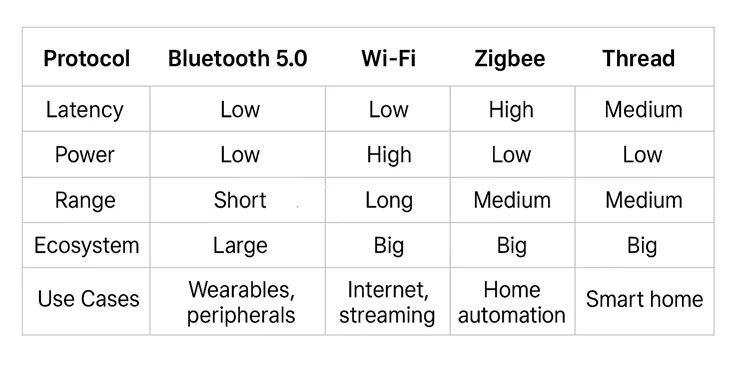
There’s no single “best” protocol; there’s the right tool for each job. Understanding tradeoffs helps you design a system that’s both resilient and future-proof.
Wi-Fi vs Bluetooth — bandwidth vs efficiency:
Wi-Fi is the right choice for high-bandwidth devices: cameras, media servers, and streaming speakers. It consumes more power and can be overkill for tiny periodic transmissions. Bluetooth is superior for low-power, low-bandwidth tasks: presence detection, beacons, and local controls. In practice, most homes will run both Wi-Fi for throughput, BLE for responsive local automation.
Bluetooth 5.0 vs Zigbee & Thread — interoperability and simplicity:
Zigbee and Thread are mature and have strengths. Thread’s IP-native design integrates well with Matter and internet services; Zigbee has an extensive installed base. But Bluetooth 5.0’s practical advantage is ubiquity: nearly every smartphone supports BLE, which simplifies pairing and diagnostics for homeowners. That means fewer brand-specific bridges and less friction at setup time.
A recommended hybrid approach:
- Use Wi-Fi for cameras and streaming devices.
- Use Bluetooth mesh lighting control for lamps and switches that benefit from instant local scenes.
- Consider Thread or Zigbee for dense sensor farms or when you need IP-native routing and Matter compatibility.
Real-home scenario: a living room with Wi-Fi cameras, Bluetooth mesh for all lamps and wall switches, and Thread-enabled temperature and humidity sensors feeding advanced automations, gives you bandwidth where needed and efficiency where it matters. This hybrid approach reduces vendor lock-in, improves resilience, and plays to the strengths of each protocol.
SECURITY AND RELIABILITY YOU CAN TRUST
Security is very important. Bluetooth 5.0 has newer ways to pair devices and uses AES-based encryption, but how secure it really is depends on how well the company that made it implements the features and keeps them up to date.
Best security practices:
- Choose reputable vendors that publish security documentation and firmware update mechanisms.
- Enable secure pairing modes; avoid legacy or unauthenticated pairing.
- For locks and access control, insist on signed firmware and multi-factor authentication where possible.
- Keep hubs and devices patched — DFU over BLE is great, but only if updates are signed and verified.
Operational reliability:
The network’s resilience comes from both protocol design and deployment choices. A mesh with strategically placed mains-powered relays (smart speakers, powered ceiling lights) will self-heal and route around failed nodes. Avoid cheap, undocumented devices for core systems — they may save money initially, but often add long-term instability and security risk.
A careful checklist:
- Validate DFU signature support for critical devices.
- Document a recovery plan: how to remove and re-provision nodes if they fail.
- Test failover — what happens if a central hub is offline? Local automations should keep working.
Implement these practices, and Bluetooth mesh environments can be both secure and dependable for everyday home use.
PRACTICAL DEPLOYMENT — BRINGING BLUETOOTH 5.0 INTO YOUR HOME
Deploying Bluetooth involves planning, testing, and iterative tuning. The following field-tested steps will make installations predictable, reliable, and low-maintenance.
Planning your mesh layout:
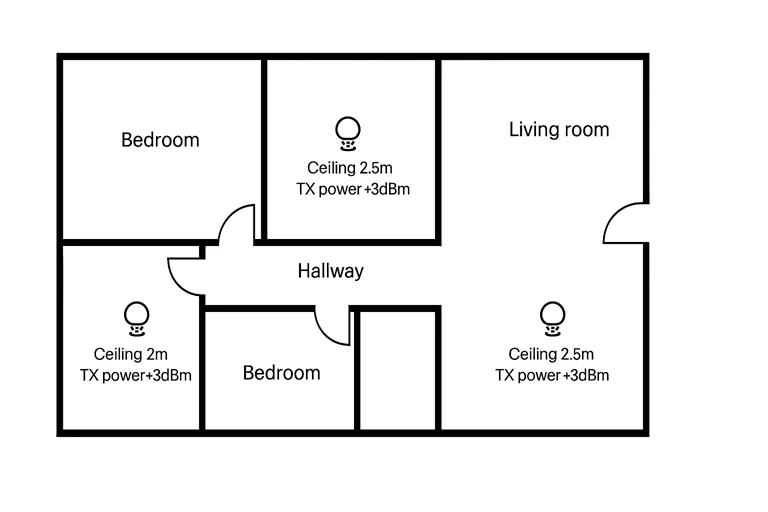
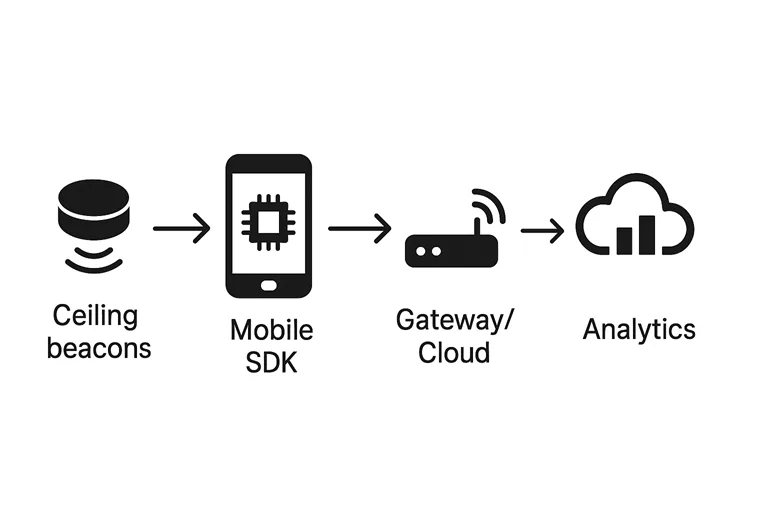
Start with a floor plan and mark hub positions (living room speaker, central hallway), mains-powered nodes (ceiling lights), and battery devices (sensors, beacons). Place relay-enabled devices in the ceiling or high on walls to get the best signal coverage and minimize any blockage.
Placement tips:
- Ceiling lights: install them at standard ceiling height and avoid deep recessed light fixtures that can interfere with the radio signal.
- Beacons: position them about 1.6 to 1.8 meters high near doors and hallways to ensure consistent detection.
- Outdoor sensors: use a coded PHY (long-range) setup and test them during the usual time they are expected to be active.
Use a deployment planner (CSV):
Create a Bluetooth Beacons deployment planner CSV. Begin with conservative settings and adjust iteratively, logging each change.
Backward compatibility checks:
Most smartphones in the last 5–6 years support BLE 5.x, but specific features (2 Mbps, long range) depend on the chipset and firmware. When buying, prefer product pages that explicitly list Bluetooth 5.0 or BLE 5.x and document supported PHYs. If you depend on long-range modes, verify the chipset (or ask the vendor) before purchase.
Step-by-step beacon automation example (hallway lights):
- Place two BLE beacons at hallway entrances, mounted at ~1.7 m to avoid low-angle interference.
- Set conservative advertising intervals to save battery but enable higher-frequency advertising triggered by motion sensors.
- Use a phone or smart speaker as the hub to detect proximity and trigger a scene: dim to 30% for passing traffic, full on if motion persists.
- Test walking speed, adjust TX power to eliminate false triggers, and record settings in your CSV.
Iterate and observe:
Making small changes to how often ads are sent and the strength of the signal can greatly impact how long the battery lasts and how often false alerts happen. It’s best to test these settings over multiple days and at different times to make sure they work consistently. Use always-on relays near dead zones and avoid clustering too many battery nodes in a single radio-shadowed area.
THE FUTURE OF SMART LIVING WITH BLUETOOTH 5.0
Bluetooth 5.0 laid foundational improvements; the Bluetooth roadmap extends those benefits. Direction finding, richer LE Audio, and deeper integration with standards like Matter make Bluetooth more context-aware and interoperable. Imagine indoor positioning precise enough to find a lost phone, or lights that adjust brightness and warmth based on who’s in the room — without cloud dependency.
The big shift is local intelligence and privacy-first automation: more decisions made on-device, less data sent to distant servers. That means faster automations, reduced latency, and better privacy. As standards converge, expect smoother cross-vendor experiences that make it easier to add devices without painful compatibility workarounds.
REAL PRODUCTS TO START WITH (SPECIFIC MODELS & AMAZON PLACEHOLDERS)
Here are practical product picks to evaluate. Replace these search placeholders with your affiliate links when ready.
- Philips Hue White & Color Ambiance Bluetooth A19 Bulb — a familiar, reliable entry point for Bluetooth mesh lighting control.
- August Smart Lock Pro (4th Gen) — a solid smart lock offering Bluetooth support and secure update paths.
- Nordic Semiconductor nRF52840 Dongle — a developer-friendly dongle to test BLE features and mesh prototypes.
- Estimote / Kontakt.io Beacons — practical beacons for presence and indoor-positioning experiments.
These choices provide a balanced mix of consumer convenience and DIY flexibility. Start with one room, learn the tuning quirks, and scale when confident.
FAQs
CONCLUSION
Imagine walking home after a long day and everything knows what to do. The lights greet you at the right warmth, the door recognizes you before you touch the handle, the thermostat nudges the temperature toward comfort, and your favorite playlist begins to play with no fiddling required. That effortless, quietly smart experience isn’t a distant promise — it’s available now, and Bluetooth 5.0 is one of the practical technologies making it possible.
Bluetooth 5.0 isn’t flashy; it’s functional. It gives you tangible improvements: longer reach so devices in garages and gardens behave; faster small-data exchanges so updates and scenes don’t stall; and low-energy profiles so sensors run for years on small batteries. Coupled with Bluetooth mesh, those gains become a reliable fabric for whole-home lighting, presence detection, and everyday automations that feel immediate and private.
If you’re ready to move beyond experiments, start with one focused project: convert a single room to Bluetooth mesh lighting control or test a beacon-based presence automation for your hallway. Try one of the products listed above — the Philips Hue Bluetooth bulbs for lighting, an August Smart Lock Pro for access, or a Nordic nRF52840 dongle if you like to tinker.
This is more than buying gadgets: it’s an investment in simplicity. Buy one well-reviewed Bluetooth 5.0 device today, tune it carefully, and watch how small, reliable automations change daily life.
Ready to start? Explore the recommended devices, pick a single room, and let Bluetooth 5.0 quietly make your home smarter and more enjoyable.

Thanks for sharing. I read many of your blog posts, cool, your blog is very good. https://www.binance.com/ru-UA/register?ref=JVDCDCK4
Thank you so much! I’m really glad you’ve been enjoying the blog and taking the time to read multiple posts. It means a lot! If there’s ever a topic you’re curious about or want me to dive deeper into, just let me know — I’m always happy to share more.