
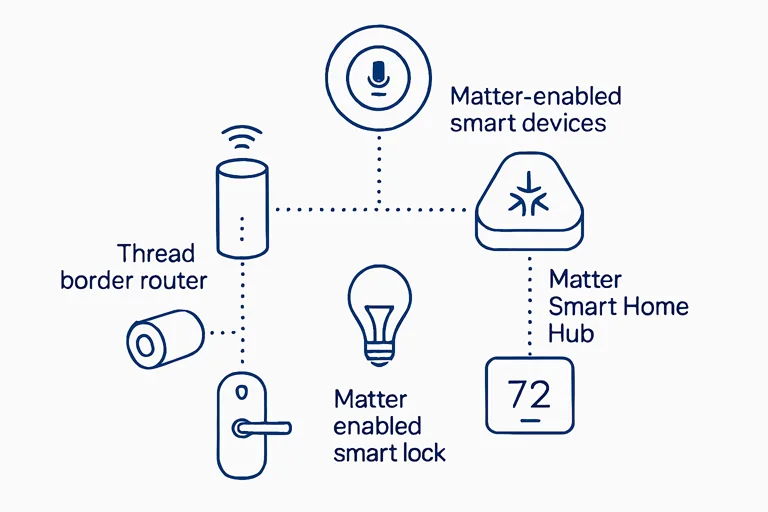
The movement toward unified, future-proof smart homes in 2025 has gained popularity. Modern homeowners are seeking more than just isolated smart gadgets—they want robust ecosystems that offer seamless control, bulletproof security, and ongoing compatibility. This is where, the latest smart home interoperability protocol, and its core wireless enablers—Wi-Fi and Thread in Matter smart homes—come into play.
Before you invest in your next smart home device, understanding how Matter, Wi-Fi, and Thread work together will help ensure your home is compatible and future-ready.
- What Is Matter? The Foundation of the Unified Smart Home
- Matter over Wi-Fi: Integration and Benefits
- Thread Protocol in the Matter Ecosystem
- Wi-Fi vs. Thread in Matter: A Technical Comparison
- Step-By-Step: Setting Up Matter over Wi-Fi and Thread
- Market Trends and Benchmarks: Where is Matter Going?
- Case Studies and Examples
- Performance Benchmarks: Thread vs. Wi-Fi Compared
- Frequently Asked Questions (FAQ)
- Conclusion: Ready to Build Your Future-Proof Matter Smart Home?
What Is Matter? The Foundation of the Unified Smart Home
Matter is a universal connectivity standard based on IP technology, created by the Connectivity Standards Alliance (CSA). It plays a central role in today’s smart home transformation. Unlike other communication protocols, Matter is a major initiative led by big companies such as Apple, Google, Amazon, and Samsung. Its goal is to remove the challenges of device compatibility in smart homes. The goal is to ensure that your smart locks, bulbs, thermostats, and appliances will all “just work” together, regardless of brand.
Key features of Matter:
- Works over multiple transport technologies: Wi-Fi, Thread, and Ethernet for device control, plus Bluetooth LE for device onboarding.
- Ensures devices from different manufacturers are compatible and secure.
- Prioritizes local control, privacy, and security by default.
Through Matter, new devices can be set up with a simple QR code scan and controlled by any major smart home ecosystem (e.g., Apple Home, Google Home, Amazon Alexa, SmartThings). Find the latest insights on Matter’s rapid adoption and device trends.
Matter over Wi-Fi: Integration and Benefits
Matter over Wi-Fi allows Matter-certified devices to communicate using your home’s existing Wi-Fi network. This is a big win for consumers: no new hardware or hubs required; connect your compatible smart bulb or plug as you would any other device.
Advantages of Wi-Fi for Matter Smart Homes
- High Bandwidth: Essential for video doorbells, security cameras, and streaming devices.
- Wide Compatibility: Most homes already have reliable Wi-Fi, so setup is straightforward.
- Direct Internet Access: Enables cloud updates, notifications, and remote control.
Wi-Fi typically requires more power than Thread, making it best suited for mains-powered devices (like smart speakers or cameras), rather than battery-powered sensors or locks.
Examples:
- Google Nest Hub as a Matter controller, or a TP-Link Tapo P110M smart plug that you pair in minutes.
Thread Protocol in the Matter Ecosystem
What is Thread?
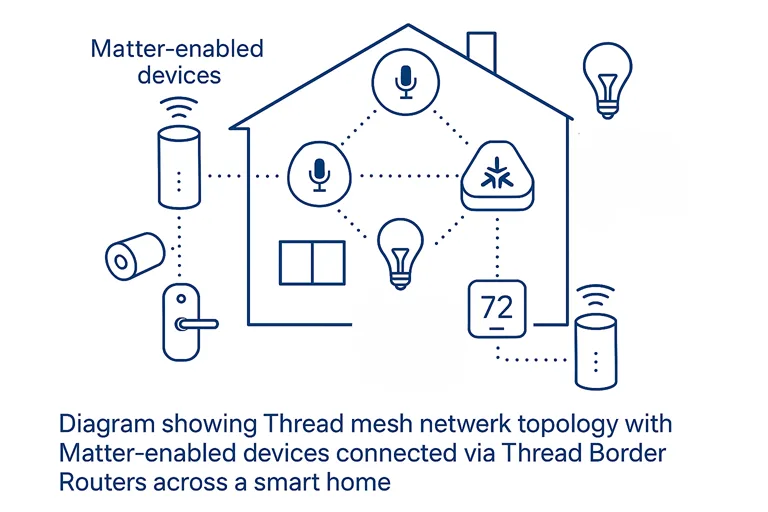
Thread is a low-power, mesh networking protocol based on IEEE 802.15.4. Uniquely, it allows smart home devices to communicate directly with each other over a reliable mesh—even in larger homes or if nodes go offline.
Why Thread Matters for Matter Devices:
- Mesh Networking: Expands range as you add powered devices (bulbs, switches) that double as signal repeaters.
- Low Power: Ideal for battery-powered sensors, door locks, and thermostats.
- Self-Healing: The network automatically reroutes if devices are offline, ensuring reliability.
- IP-Native: Every device has its own IPv6 address, enabling direct communication and easier future upgrades.
Thread requires a Border Router—a device (like an Apple HomePod Mini, Amazon Echo 4th Gen, or some Google Nest models) that connects Thread networks to your main home Wi-Fi and the Internet.
Typical Thread Devices:
- Battery sensors, smart locks, thermostats, and motion detectors.
See detailed Thread mesh performance analysis in Applied Sciences.
Wi-Fi vs. Thread in Matter: A Technical Comparison
Let’s break down the strengths, weaknesses, and best use cases for each in the Matter smart home.
| Feature | Wi-Fi | Thread |
|---|---|---|
| Connectivity Type | Direct IP-based, high bandwidth | Mesh network, low bandwidth |
| Power Consumption | High (not ideal for battery-powered devices) | Low (optimized for battery efficiency) |
| Latency | Low latency for real-time applications | Very low latency within mesh network |
| Reliability | Depends on router strength and congestion | Self-healing mesh ensures robust connectivity |
| Security | WPA3 encryption, firewall-dependent | Built-in AES encryption, device-to-device |
| Use Cases | Cameras, smart speakers, video doorbells | Sensors, smart locks, lights, thermostats |
| Matter Compatibility | Fully supported for high-data Matter devices | Native protocol for low-power Matter devices |
| Hub Requirement | No hub needed; connects via router | Requires a Thread Border Router (e.g. Nest Hub, Apple TV) |
| Scalability | Limited by router capacity | Highly scalable with mesh topology |
| Interference | Susceptible to congestion from other devices | Less interference due to low-power mesh signals |
Step-By-Step: Setting Up Matter over Wi-Fi and Thread
Modern Matter platforms aim to streamline onboarding and interoperability, but each network type involves distinct steps.
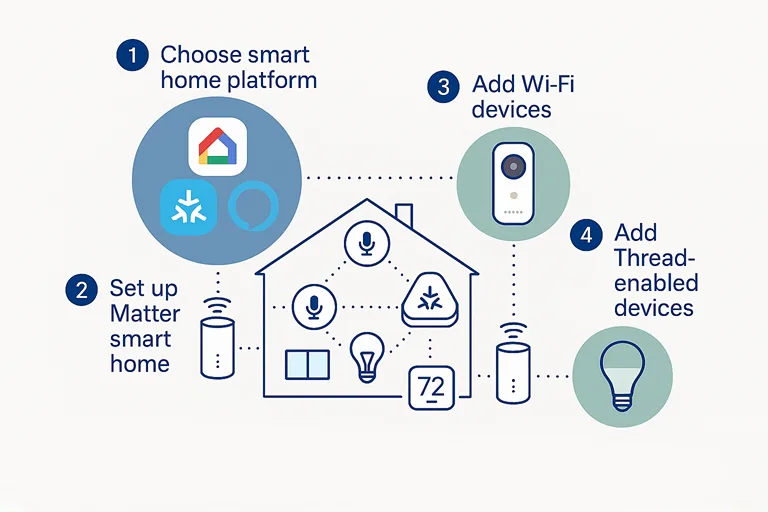
1. Decide Your Core Smart Home Ecosystem
Choose your Matter “platform”—Apple HomeKit, Google Home, Amazon Alexa, or Samsung SmartThings. Each requires a corresponding Matter “controller” device—like a HomePod, Echo, or Nest Hub—which often doubles as a Thread Border Router.
2. Set Up Your Matter Controller & Thread Border Router
- For Wi-Fi devices: Ensure your Matter controller (e.g., Amazon Echo or Apple TV 4K) is set up and connected to your main Wi-Fi.
- For Thread devices: Confirm you have a controller with Thread Border Router capability enabled (such as Apple HomePod Mini, Google Nest Hub 2nd Gen, Samsung SmartThings Station). You only need one Border Router—but adding more increases reliability.
3. Commission Devices Using QR Codes
All Matter devices have a setup code (usually QR) on the product or packaging. Use your ecosystem’s app to scan the code—the device receives network credentials and joins the “Matter Fabric” for secure communication.
4. Place and Automate Devices
- Place powered devices (like bulbs and switches) to maximize Wi-Fi or Thread mesh coverage.
- Set up automations using your platform’s routines, scenes, or “flows”—e.g., “Lights on at sunset,” “Lock door when all users leave.”
Pro Tips:
- Place Thread sensors near Border Routers for best reliability.
- Use Wi-Fi channels with minimal congestion (2.4 GHz for sensors, 5 GHz for video, etc.).
- For multi-user homes, leverage Matter’s “multi-admin” feature to allow control across family accounts and apps.
Market Trends and Benchmarks: Where is Matter Going?
Rapid Growth and Adoption
- In 2025, over 80% of newly released smart home devices are Matter-certified, cutting through decades of frustrating incompatibility.
- Sales of smart plugs, energy meters, and sensors have jumped as low-cost Matter-ready devices hit the market, especially those that rely on Thread mesh for reliable operation.
- Major brands such as LG, Midea, Aqara, Nanoleaf, TP-Link, Philips Hue, and Kwikset have committed their flagship lines to Matter across both Wi-Fi and Thread.
Performance Highlights
- Thread mesh regularly supports 250+ devices per network with sub-20ms latency in most home environments, and its self-healing nature means even if a node drops offline, automations continue smoothly.
- Wi-Fi-based devices now commonly feature “sleep” modes and energy consumption reductions (crucial for plugs and switches), but Thread remains king for ultra-low-power applications.
Security
- All Matter communication is end-to-end encrypted. Wi-Fi and Thread both use mandatory AES-128 encryption, while Matter adds certificate-based device attestation to block spoofing and ensure devices are genuine.
Emerging Trends
- Voice assistants (like Alexa) integrate natively with Matter-over-Thread devices—no custom skills or extra bridges required.
- Companies are moving towards energy management use cases—combining Thread-powered devices (thermostats, smart plugs) with solar, EV chargers, and dynamic energy schedules.
- Elder care and health is a new frontier—low-power sensors on Thread make it possible to monitor air quality, detect falls or track sleep patterns, even in houses with spotty Wi-Fi coverage.
Case Studies and Examples
- Kwikset Halo Select Smart Lock: Built for users to choose Wi-Fi or Thread/Matter setup. Uses robust Nordic nRF5340 chips for dual-protocol support. Thread improves battery life and reliability for remote doors.
- LG Matter-Ready TVs: Use Wi-Fi for video, Thread mesh for low-latency device control, and act as Thread Border Routers and Matter controllers—centralizing automation without added hubs.
- Midea’s Matter Appliance Lineup: Showcases interoperable appliances—from ACs to robot vacs—that connect via Wi-Fi or Thread, allowing one-tap control through any major ecosystem.
- Aqara Camera and Hub G5 Pro: Offers both Thread and Zigbee for Matter, future-proofs via frequent OTA firmware updates, and allows users to automate, monitor, and secure their entire home across platforms.
Performance Benchmarks: Thread vs. Wi-Fi Compared
Benchmark studies and academic reviews consistently show:
- Thread Mesh Networks: Support hundreds of low-power, low-data devices (over 200 per Mesh) with sub-20ms latency and self-healing that routes around local failures.
- Wi-Fi Networks: Ideal for 10-30 high-bandwidth devices, but packet loss and increased latency occur as more sensors are added; battery-powered devices drain rapidly.
- Hybrid Deployments: Using Wi-Fi for cameras and media, and Thread for sensors/locks, achieves best reliability and scalability.
Extensive technical benchmarks are available from Silicon Labs and MDPI.
Frequently Asked Questions (FAQ)
Conclusion: Ready to Build Your Future-Proof Matter Smart Home?
Matter is rapidly becoming the backbone of modern, unified smart homes, breaking down brand, protocol, and platform walls for good. Wi-Fi enables seamless video streaming and power-hungry appliances. Thread brings reliability, ultra-low-power battery life, and massive scalability for sensors and automation.
Want to get the most out of your smart home investment? Start with a robust Matter-capable hub, make informed choices on when to use Wi-Fi or Thread, and buy Matter-certified devices from reputable brands. Mixing both protocols will give you the coverage, security, and future-readiness that today’s—and tomorrow’s—smart homes require.
For expert device selection or setup advice, check out industry-leading brands, read CSA’s official Matter pages, or consult with a local smart home professional. The era of reliable, open, and scalable home automation is here—and Wi-Fi and Thread are the twin engines that make it work!
Curious which smart home gear works flawlessly with your chosen ecosystem? Explore the latest Matter-certified devices or get matched with a trusted home setup expert to build your secure, seamless home today.

Thanks for sharing. I read many of your blog posts, cool, your blog is very good.
Thank you so much! I’m really glad you’re enjoying the blog and taking the time to read multiple posts. It means a lot! If there’s ever a topic you’d like me to cover or explore further, just let me know — I’d be happy to dive into it.