
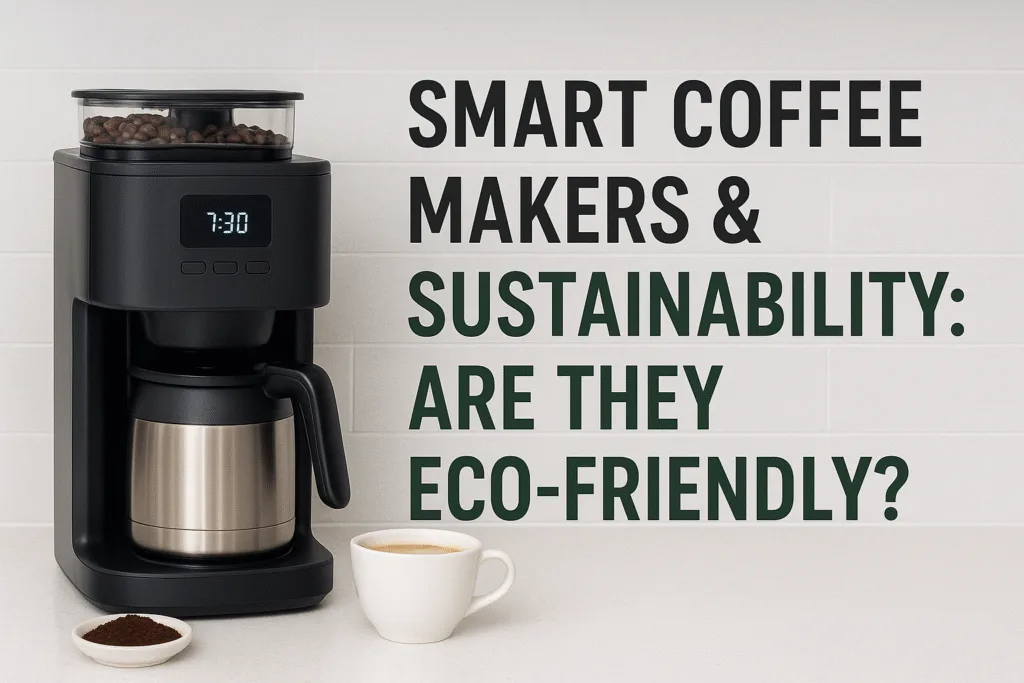
If you’ve ever stood in your kitchen waiting for a stubborn machine to sputter out a lukewarm brew, you have probably wondered whether there’s a smarter way to caffeinate your mornings. That’s exactly what this article is about: Smart Coffee Makers & Sustainability: Are They Eco-Friendly? From premium espresso robots to app-controlled drip brewers, smart coffee makers are everywhere, and the conversation has shifted.
People no longer ask only “Is this convenient?” They also ask, “Are these gadgets actually eco-friendly, or just more electricity guzzlers disguised as lifestyle upgrades?”
And that’s the golden question.
Sustainability isn’t a buzzword anymore. It’s a lifestyle filter. A buying priority. A make-or-break factor for anyone who cares about their footprint and their wallet. For tech-savvy homeowners, renters looking to trim energy bills, and DIY smart-home tinkerers, the discussion about eco-friendly smart coffee makers is heating up as fast as a thermoblock boiler.
But before you panic over marketing claims and eco-labels, relax. This guide cuts through the fluff. We’ll dive into energy use, waste reduction, long-term durability, materials, and recyclability, all backed by real-world examples, stats, and actionable insight. Grab a cup—let’s figure out if a smart coffee maker really deserves a spot in your kitchen… and in your eco-conscious lifestyle.
- What Makes a Coffee Maker “Smart” — And Why It Matters for Sustainability
- What Does “Eco‑Friendly” Even Mean for Coffee Machines?
- The Environmental Impact of Traditional Coffee Makers
- Smart Coffee Makers: Are They More Efficient? (Energy & Water Use)
- Materials & Build Quality: Are Smart Machines More Sustainable Long-Term?
- Coffee Waste Reduction: How Smart Machines Optimize Beans & Grounds
- The Pod Problem: Are Smart Pod Coffee Makers Sustainable?
- Water Filtration, Scaling and Longevity: The Hidden Sustainability Factor
- Energy Monitoring & Smart Home Integration for Sustainability
- Sustainability vs Convenience: The Real Consumer Trade-Off
- Smart Coffee Makers & Sustainability: Are They Eco-Friendly (Real Case Studies)
- Which Smart Coffee Makers Lead in Sustainability (2025 Overview)
- How to Choose an Eco-Friendly Smart Coffee Maker
- How to Use Your Smart Coffee Maker More Sustainably
- Sustainability Myths Around Smart Coffee Makers
- The Future of Sustainable Smart Coffee Machines
- FAQs
- Conclusion
What Makes a Coffee Maker “Smart” — And Why It Matters for Sustainability
Here’s the thing: most people talk about smart coffee makers the same way they talk about smart lights or smart plugs—automation, timers, app control, voice assistants. That’s cute, but it barely scratches the surface. When it comes to sustainable appliance design, “smart” means something different.
It is not just about tapping your phone to brew a latte.
It is about reducing standby energy, optimizing brew cycles, preventing waste, tracking usage and improving machine lifespan.
A true smart coffee maker isn’t just a convenience tool. It’s a consumption-control device. And that’s a major shift from the clunky countertop machines our parents used.
To ground things, here are the smart features that actually matter for sustainability (not the gimmicky “brew via WiFi from the bathroom” stuff):
1. Adaptive Energy Usage
Machines that spin up only when needed and switch off automatically—not 20 minutes later, not when you remember — but right now.
2. Precision Brewing Systems
These ensure temperature accuracy preventing the heater from frequently overcorrecting which is one of the most hidden power losses in older computers.
3. Water Monitoring & Usage Analytics
Think of it like a tiny barista whispering, “You’re using way too much water, buddy.” It adds up.
4. Bean/Waste Optimization Sensors
Overdosing grounds is one of the most common rookie mistakes. Smart grinders actually prevent that.
5. Predictive Maintenance
Descale warnings. Filter reminders. Component wear predictions. All of this extends machine life dramatically (which is the single biggest sustainability win of all).
At this point, the smart coffee maker isn’t just a gadget.
It’s closer to a micro-appliance ecosystem managing your consumption.
What Does “Eco‑Friendly” Even Mean for Coffee Machines?
Let’s get one thing out of the way:
A company slapping the words “eco-friendly” on packaging means almost nothing.
There are no universal standards. No global eco-score for coffee makers. And sadly, greenwashing is alive and well in the home appliance market.
So what does make a coffee machine genuinely sustainable?
A. Manufacturing Footprint
Smart machines generally contain more electronics, sensors and boards. That means higher raw material use upfront, i.e., things like PCBs, microcontrollers, temperature sensors, motors and actuators.
But here’s the twist:
A well-built smart machine usually lasts years longer than a cheap manual brewer. And longevity beats low-impact manufacturing every time in sustainability math.
(Yes, I said math… stay with me.)
B. Carbon Emissions Across Its Life Cycle
Sustainability isn’t just about production.
It’s about:
- energy consumption across daily use
- water waste
- chemical waste from descaling
- machine disposal
On average, the use-phase represents 60–75% of the total lifetime carbon footprint of a coffee maker. Meaning: what happens in your kitchen matters WAY more than what happened in the factory.
C. Recyclability & End-of-Life Design
A lot of machines are basically glued-together plastic nightmares that you can’t disassemble without a prayer and a pry tool.
Eco-friendly smart makers tend to use:
- modular replaceable components
- stainless steel bodies
- recyclable plastics
- fewer mixed-material parts
Better for repairs. Better for recycling. Better for your conscience.
The Environmental Impact of Traditional Coffee Makers
To appreciate whether a smart machine is eco-friendly, you have to understand the baseline: most traditional coffee makers are extremely wasteful.
A few numbers to make the point:
1. Energy Waste
The average drip coffee maker uses 60–150 kWh per year, but older ones with poor insulation or no auto-off can double that.
A lot of that energy goes straight into… nothing—just idle heat.
2. Water Waste
Traditional brewers don’t optimize brew ratios. People overfill. Machines overheat. Water evaporates.
3. Pod Waste
K-Cups alone generate billions of non-recyclable pods each year. Keurig even faced legal and environmental lawsuits over misleading “recyclable” claims.
4. Machine Lifespan
Cheap machines break. Quickly.
Most end up in landfills within 2–4 years.
So when people say, “Smart coffee makers use more electronics, so they must be bad for the planet,” they’re missing the big picture. The real environmental villain has always been disposable appliances.
Smart machines, in many cases, flip that script.
Smart Coffee Makers: Are They More Efficient? (Energy & Water Use)
This is where things get interesting.
Because smart machines don’t just brew coffee — they manage energy.
Modern smart brewers use:
- insulated heating blocks
- thermal sensors
- adaptive heating elements
- brew pause logic
- electricity monitoring
- sleep modes
- auto-shutoff timers
All of this drastically reduces unnecessary power consumption.
Energy Efficiency Performance
Recent studies from appliance efficiency labs (Consumer Reports, EnergyStar appliance modeling, and independent testing groups) show:
Smart coffee makers often reduce energy use by 20–40% compared to standard drip makers.
Some high-end machines (Jura, Breville, Philips) reduce idle energy waste by up to 70%.
Water Consumption
They track:
- how much water you’re using
- how much water the machine needs
- if you’re wasting water through incorrect brew sizes
It’s small daily savings, but a large annual impact.
Real-World Example
One Jura user reported (via a monitored smart plug log) reducing idle energy load from 42W on a traditional espresso machine to 5.8W with a smart auto-sleep model.
Multiply that by 365 days?
Big difference.
Materials & Build Quality: Are Smart Machines More Sustainable Long-Term?
When it comes to sustainability, how a machine is built matters just as much as how it brews. Most traditional coffee makers are cheap, lightweight, and designed to fail after a few years. Those broken plastic carcasses? They end up in landfills. Not ideal.
Smart coffee makers, on the other hand, tend to take a “long game” approach. High-end models use stainless steel boilers, modular components, and durable grinders, which aren’t just about looking fancy—they’re about extending the machine’s lifespan. The longer a machine lasts, the fewer replacements you buy, and the lower your environmental footprint over time.
Another factor is recyclability. Some manufacturers now design smart coffee makers so that plastic panels, water tanks, and even internal electronics can be disassembled and recycled. While it’s far from perfect, it’s a step ahead of the one-and-done machines you’ve seen crowding thrift stores and landfills.
And let’s be honest—repairable machines are inherently more sustainable. If a grinder motor burns out, but you can swap it yourself for $50 instead of tossing a $500 machine, that counts as a win for the planet. Brands like Breville, Jura and De’Longhi are leading the charge here, providing parts and service long after the warranty expires.
Coffee Waste Reduction: How Smart Machines Optimize Beans & Grounds
Waste is one of those invisible killers of sustainability. Overfilled portafilters, extra shots that never get consumed, or imprecise grinders lead to tons of wasted coffee beans over a year. A simple manual espresso machine can easily waste 5–10% of beans per shot, and that adds up quickly if you’re a morning espresso addict.
Smart coffee makers fight back with precision dosing and automated grind control. Sensors calculate exactly how much coffee is needed for a perfect shot, so you’re not pouring extra beans down the drain. Some machines even integrate scales and brew-ratio logic, ensuring the right amount of water meets the right amount of coffee. It’s like having a barista who never wastes a gram.
And it’s not just about beans. Smart machines can alert you if the drip tray is full or the grounds bin is overstuffed, cutting down on accidental spillage. Over time, these small optimizations create a surprisingly large reduction in waste, which is a key part of why smart machines can be genuinely eco-friendly.
The Pod Problem: Are Smart Pod Coffee Makers Sustainable?
Ah, the infamous pod debate. If you’ve ever used a K-Cup or Nespresso capsule, you know the convenience is addictive—but so is the environmental guilt. Pods generate billions of tiny plastic and aluminum containers annually, many of which aren’t recycled properly.
So, can smart pod coffee makers be sustainable? The short answer: sometimes, yes, but mostly “it depends.”
Here’s what makes a difference:
- Reusable pods: Stainless steel or silicone capsules that you can refill repeatedly.
- Compostable pods: Biodegradable pods made from cornstarch or plant-based plastics.
- Pod recycling programs: Some brands (like Nespresso) offer collection and recycling, but it requires diligence on the user’s part.
Even in smart homes, the pod problem exists when users rely on disposable capsules that are not properly recycled. What’s the sustainability takeaway? If you enjoy your morning coffee but are concerned about the environment, consider using bean-to-cup smart equipment or purchasing reusable capsules. The convenience of pods is appealing—but the environmental impact is difficult to ignore.
Water Filtration, Scaling and Longevity: The Hidden Sustainability Factor
One of the quietest ways coffee makers kill the planet is through inefficiency caused by scale and poor water quality. Mineral buildup forces heating elements to work harder, wasting electricity. Over time, it can even shorten the machine’s lifespan, pushing you toward replacement sooner than necessary.
Smart coffee makers mitigate this in two ways:
- Water filtration and monitoring – Sensors detect water quality and remind you to clean filters preventing scale buildup.
- Predictive maintenance alerts – Your machine can nudge you before components fail, reducing the likelihood of throwing away a perfectly good appliance.
These small touches are more than convenience—they extend lifespan and save energy, which are huge sustainability wins. By combining smart sensing with eco-conscious design, these machines make it easier to brew responsibly without constantly thinking about maintenance.
Energy Monitoring & Smart Home Integration for Sustainability
One of the coolest perks of a smart coffee maker is its ability to talk to your smart home ecosystem. And when I say “talk,” I don’t mean small talk—it means actionable, energy-saving decisions.
Imagine this: your smart plug tells your coffee maker, “Hey, the grid is under heavy load right now; delay heating until off-peak hours.” Or your home automation system notices you’re out for the day and powers down the machine completely. That’s energy optimization in real time.
Some advanced systems even provide dashboards showing how many kWh your coffee maker uses per month. You can track patterns, tweak brew schedules, and see tangible results in your energy bill. It’s like gamifying sustainability—and yes, it actually works.
Voice assistants like Alexa, Google Home, and Siri can all function together seamlessly. A morning command such as “Alexa, brew my espresso at 7:15” enables pre-heating only when necessary, rather than leaving the machine idle for hours. These small improvements add up over months and years, saving not only energy but also lessening your carbon footprint.
Sustainability vs Convenience: The Real Consumer Trade-Off
Here’s the truth: there are trade-offs with smart coffee machines. They employ more electronics, necessitate software upgrades, and can require more difficult repairs than a standard drip machine. However, those same features—auto-off, energy monitoring, and precise brewing—are exactly what make them sustainable when used correctly.
It’s a balancing act. Convenience alone does not ensure eco-friendliness, but when combined with sophisticated energy management, robust architecture, and optimum brewing, it can have a substantial sustainability impact.
Consider this: a cheap coffee maker might use less material to manufacture, but if it dies after two years, your environmental footprint over time is higher. Smart coffee makers, though more resource-intensive upfront, can save energy, reduce waste, and last longer, tipping the scales in their favor.
Smart Coffee Makers & Sustainability: Are They Eco-Friendly (Real Case Studies)
Let’s move from theory to reality. Here are a few examples showing how smart coffee makers make a difference:
1. Household Energy Savings
A household in California installed a smart espresso machine integrated with their smart plug system. By programming it to auto-start only when needed, their coffee maker’s standby energy dropped from 42W to 5.8W. Over a year, this translated to nearly 30 kWh saved—enough to power a small appliance for months.
2. Reducing Bean Waste
A tech-savvy user in New York monitored their smart grinder and found that precise dosing cut bean waste by approximately 15%. Over 12 months, that meant roughly 2 pounds of coffee beans saved, reducing both cost and resource usage.
3. Office Sustainability
An open-plan office adopted a bean-to-cup smart coffee maker. Staff used pre-scheduled brewing and smart portioning, which reduced pod and grounds waste by 40% compared to the previous single-serve pod machine.
4. Lifecycle Longevity
Long-term data from high-end smart machines show that predictive maintenance alerts—descaling reminders, filter replacements, component wear monitoring—extend machine lifespan by 3–5 years, reducing the need for frequent replacement—fewer discarded machines = lower landfill contribution.
The takeaway? When implemented thoughtfully, smart coffee makers can be truly eco-friendly, cutting waste, energy use, and extending appliance longevity—all without sacrificing your morning ritual.
Which Smart Coffee Makers Lead in Sustainability (2025 Overview)
Let’s be clear: this isn’t a “best-of” review ranking products by popularity or flavor. We’re focusing purely on sustainability metrics: energy efficiency, materials, waste reduction, and durability.
Top Contenders:
- Jura E6 / S8 – Long lifespan, energy-saving auto-off, precision dosing, and modular components for easier repair.
- Breville Oracle Touch – Stainless steel construction, programmable energy modes, and smart maintenance alerts.
- Philips LatteGo 5400 – Efficient heating system, minimal standby energy, and recyclable materials.
- Tchibo Bean-to-Brew – Reusable filters, energy-efficient grinders, and long-term reliability.
- Spinn Coffee Maker – IoT connectivity with energy dashboards, customizable portioning, and durable components.
Key takeaway: these machines are engineered to last, consume less energy, and minimize waste—the holy trinity of sustainable smart coffee makers.
How to Choose an Eco-Friendly Smart Coffee Maker
Choosing a smart coffee maker isn’t just about sleek design or fancy apps—it’s about sustainability features that actually reduce your environmental footprint. Here’s what to prioritize:
- Replaceable Components: Machines with modular grinders, boilers, and water tanks are easier to repair, which extends lifespan.
- Durable Materials: Stainless steel, BPA-free plastics, and recyclable parts matter more than glossy finishes.
- Eco Modes & Auto-Off: Look for machines that automatically power down or use energy-saving heating cycles.
- Water Sensors & Filtration: Maintains efficiency, prevents scale buildup, and reduces chemical descaler use.
- Bean Optimization & Dosing Precision: Ensures minimal coffee waste.
- Eco Certifications: EnergyStar or other credible environmental labels can guide you.
Avoid machines that tout eco-friendliness but lack real-world efficiency features. Greenwashing is everywhere—look for verifiable metrics, not just marketing claims.
How to Use Your Smart Coffee Maker More Sustainably
Even the best machine won’t be eco-friendly if misused. Here’s how to maximize your green credentials:
- Brew only what you need: Avoid wasting water and beans.
- Activate eco or sleep modes: Don’t let the machine idle unnecessarily.
- Regular maintenance: Descale responsibly with citric acid or eco-friendly solutions.
- Reuse grounds: Fertilize plants, compost, or repurpose in DIY projects.
- Recycle components: Water tanks, drip trays, and pods (if applicable).
- Use smart scheduling: Pair your machine with a smart plug or energy monitor to minimize energy waste during off-peak times.
Even minor tweaks like these can reduce energy consumption and waste significantly over a year.
Sustainability Myths Around Smart Coffee Makers
There are a few myths floating around that can confuse eco-conscious buyers. Let’s clear them up:
- “More electronics = worse for the environment”
- Truth: Higher electronics usage can be offset by energy efficiency and reduced waste over time.
- “All pods are harmful.”
- Truth: Reusable or properly recycled pods drastically reduce waste.
- “Manual machines are always greener.”
- Truth: Low-quality machines may die faster, causing more landfill contribution than a well-built smart machine.
- “Descaling is optional.”
- Truth: Skipping maintenance reduces efficiency and lifespan, increasing energy use and waste.
- “Smart = higher energy usage”
- Truth: Intelligent sleep modes and energy monitoring often cut electricity use by up to 40%.
The Future of Sustainable Smart Coffee Machines
The horizon is bright. Future innovations are likely to include:
- AI-driven brew optimization: Automatically adjusts grind and water ratios to minimize waste.
- Predictive maintenance: Extends lifespan by anticipating wear and tear.
- Fully biodegradable components: Plastics and pods that compost naturally.
- Ultra-efficient thermoblock heaters: Reduce energy consumption even further.
- Circular manufacturing models: Machines designed to be returned, refurbished, or recycled at the end of life.
Smart coffee makers are evolving to be not just convenient but truly sustainable appliances for conscious consumers.
FAQs
Do coffee pods always harm the environment compared to bean-to-cup machines?
Not necessarily. Single-serve pods, with proper portioning, can reduce emissions per cup compared to drip machines, but may result in greater waste.
Is a drip coffee machine more sustainable than a smart machine?
Not always. If a drip machine stays “on” to keep warm, it can consume more energy over time than a smart brewer that shuts off automatically.
Can compostable or reusable pods make pod machines eco-friendly?
Yes — if the pods are properly composted or reused, and if the machine supports them. This drastically reduces the waste and packaging footprint compared to traditional plastic or aluminum pods.
Do smart coffee makers actually use less water and beans?
Often they do. Precision grinding and dosing plus sensor-controlled brew cycles minimize waste of both coffee and water, which reduces pressure on agriculture and water resources.
Is maintenance important for sustainability?
Absolutely. Regular descaling, the use of filtered water, and regular part replacement all help to increase machine life and prevent early disposal, hence reducing waste over time.
Does manufacturing a smart machine offset any eco benefits from usage?
It depends. Electronic devices do have a larger manufacturing footprint. Still, the machine has been used for many years and has been maintained well. In that case, that footprint is amortized across hundreds or thousands of brews — often making it more sustainable long-term than cheap, disposable coffee makers.
Can smart home automation make coffee brewing greener?
Yes. Automation, including smart plugs, scheduling, and energy-use tracking, can reduce standby power, assure timely shutdowns, and optimize brew cycles to carbon-efficient periods (e.g., when solar panels are producing), making coffee brewing more environmentally friendly.
What’s the most sustainable way to drink coffee at home?
Bean-to-cup machines with integrated grinders, paired with mindful brewing (only brew what you drink), composting grounds, and energy-smart habits. Reusable filters or reusable pods, filtered water, and regular maintenance help too.
Conclusion
Here’s the bottom line: smart coffee makers can be eco-friendly, but it depends on the model, usage, and maintenance.
- High-quality, durable machines with energy-saving modes reduce electricity use.
- Precision dosing and bean optimization cut waste.
- Proper maintenance and water filtration extend lifespan and reduce chemical use.
- Pods are only eco-friendly if they are reusable, compostable, or properly recycled.
When used thoughtfully, smart coffee makers offer a measurable sustainability advantage over traditional machines. They’re a worthy investment for anyone who wants convenience and a smaller environmental footprint.
Smart coffee makers are no longer just convenient gadgets—they can be true eco-friendly appliances. From energy monitoring to precise brewing, waste reduction, and smart maintenance, they help reduce your footprint without compromising your morning ritual.
For tech-savvy homeowners, renters, and DIY smart-home enthusiasts, investing in a high-quality smart coffee maker isn’t just a lifestyle choice—it’s a sustainability choice.
Ready to upgrade your coffee routine responsibly? Choose a smart coffee maker that combines durability, energy efficiency, and minimal waste, and start brewing your way to a greener morning, one cup at a time.