
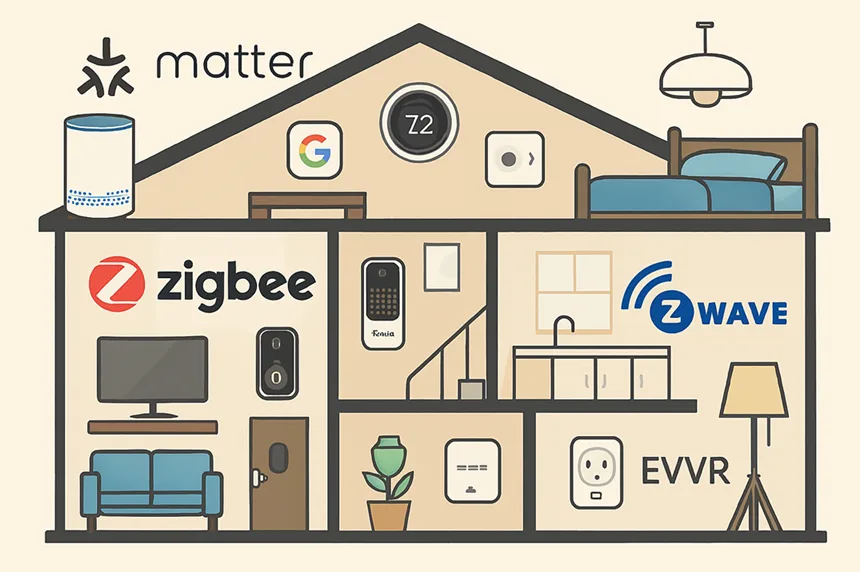
Choosing the right smart home protocol is crucial for a seamless home automation experience. With hundreds of devices in your house – from light bulbs and thermostats to locks and sensors – you want them to talk to each other, not to mention your phone or voice assistant. The challenge? Many devices speak different “languages.” Enter the contenders: Matter, Zigbee, and Z-Wave. Each offers a path to connect your devices, but which one truly wins for your needs? In this deep dive, we break down the history, technology, pros, and cons of each protocol, compare their key specs, and help you decide which smart home standard to choose.
What Are Smart Home Protocols and Why They Matter
Smart home protocols are the set of rules that enable your devices to share information. Imagine them as languages or communication standards that determine how smart devices such as lights, door locks, and sensors talk to each other over a network. By using a common protocol, devices from different brands can share information and commands – for example, turning lights on or adjusting the thermostat via a smartphone app. Effective smart home connectivity relies on these protocols to create an interconnected ecosystem.
Over the past decade, smart home systems have evolved from siloed products to complex networks. Now homeowners can connect dozens of devices, with standards like Wi-Fi, Bluetooth, Zigbee, Z-Wave, Thread, and the newcomer Matter. But not all protocols are equal. They differ in range, power use, security, device compatibility, and more. Understanding these differences is key to building a reliable, efficient system. As the Smart Home Maniac blog notes, “Zigbee, along with Matter and Z-Wave, offers distinct advantages for your smart home ecosystem”, but each excels in different areas. In other words, the “best” protocol depends on your specific needs: battery life, network size, brand mix, and whether you value seamless interoperability over range.
Understanding Matter
Developed by the Connectivity Standards Alliance (CSA, formerly the Zigbee Alliance) and backed by Apple, Google, Amazon, Samsung and others, Matter is an open-source smart home standard launched in late 2022. It was created to solve the biggest smart home headache: fragmentation. By using Internet Protocol (IP) – the same foundation as Wi-Fi and Ethernet – Matter allows devices from different manufacturers to work together. In effect, Matter is like a universal translator for smart home devices. As one expert explains, “Matter unifies smart home ecosystems by enabling native compatibility between Apple HomeKit, Google Nest, and Amazon Alexa devices”, removing the need for brand-specific hubs.
How Matter Works
Matter itself is not a radio frequency like Zigbee or Z-Wave. Instead, it’s a software protocol layer that runs on existing networks. Currently, Matter devices can use Wi-Fi, Ethernet, or Thread (a low-power mesh network standard) for communication. Devices are set up using Bluetooth LE initially (for pairing), but then operate over the chosen network. This means a Matter device might use Wi-Fi for video streaming or Thread for mesh sensor networks, all under the same Matter standard. The goal is “universal compatibility” – for example, a Matter light bulb can be controlled from Apple Home, Google Home, or Amazon Alexa seamlessly.
Among Matter’s key features are strong security (end-to-end encryption and device certificates), easy setup (scan a QR code), and local control (it can work on your LAN without Internet). Matter’s certification process ensures high interoperability and privacy. One source notes Matter’s main goals are “universal compatibility, local control (faster, more secure), simplified setup, increased privacy and security, and future-proofing”. In practice, this means once you buy a Matter device, it should work across brands and be updated over time to add new features – making it very future-proof.
Pros of Matter
- Interoperability: Matter is designed so that any Matter-certified device can interoperate with any other in major ecosystems (Amazon, Apple, Google, etc.). For example, one Matter bulb can show up in all your smart home apps simultaneously.
- Security: Matter enforces modern security standards. Devices use digital certificates and AES/ECC encryption to authenticate and communicate securely. This helps prevent unauthorized access.
- Local Control & Low Latency: Matter can run devices locally without relying on the cloud. Commands go directly over your home network, resulting in faster response (no internet lag) and continued operation during outages.
- Ease of Setup: Pairing a Matter device is usually as simple as scanning a QR code or NFC tag, much simpler than some older methods.
- Future-Proof: With major tech companies behind it, Matter is evolving. New device categories (cameras, appliances, vacuums, etc.) are being added to the standard (Matter 1.2, 1.3 updates through 2025).
Cons of Matter
- New Ecosystem: Matter is still the latest protocol. Many existing smart home devices (especially older Zigbee/Z-Wave gadgets) don’t natively speak Matter yet. Most Matter-certified products arrived after 2022. If you have a lot of legacy devices, you may need bridges or hubs to integrate them.
- Device Support Gaps: As of 2025, some device types are still limited under Matter. For example, support for cameras, garage door openers, and vacuums is just being introduced. Expect more categories to come, but coverage isn’t complete yet.
- Networking Dependency: Matter over Thread requires a Thread border router (like a HomePod or Nest Hub). If that goes offline, local Matter devices can lose connectivity. (Over Wi-Fi, this is less of an issue.)
Overall, Matter is heralded as the “smart home standard we’ve been waiting for”, because it “finally delivers what smart homes always needed”. It doesn’t replace Zigbee or Z-Wave immediately, but adds a universal layer on top of them.
Understanding Zigbee
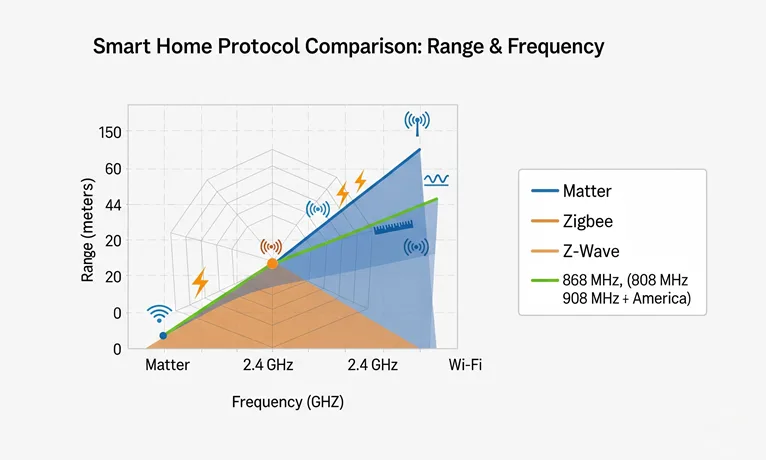
Zigbee has been a leading smart home protocol for years. It is a wireless mesh networking standard based on IEEE 802.15.4, designed for low-power, low-data-rate applications. Zigbee typically operates on the globally available 2.4 GHz band (though in some regions it can use 868 MHz or 915 MHz). It was created by the Zigbee Alliance (now CSA) to allow devices like smart bulbs, sensors, and switches to communicate reliably in a home.
How Zigbee Works
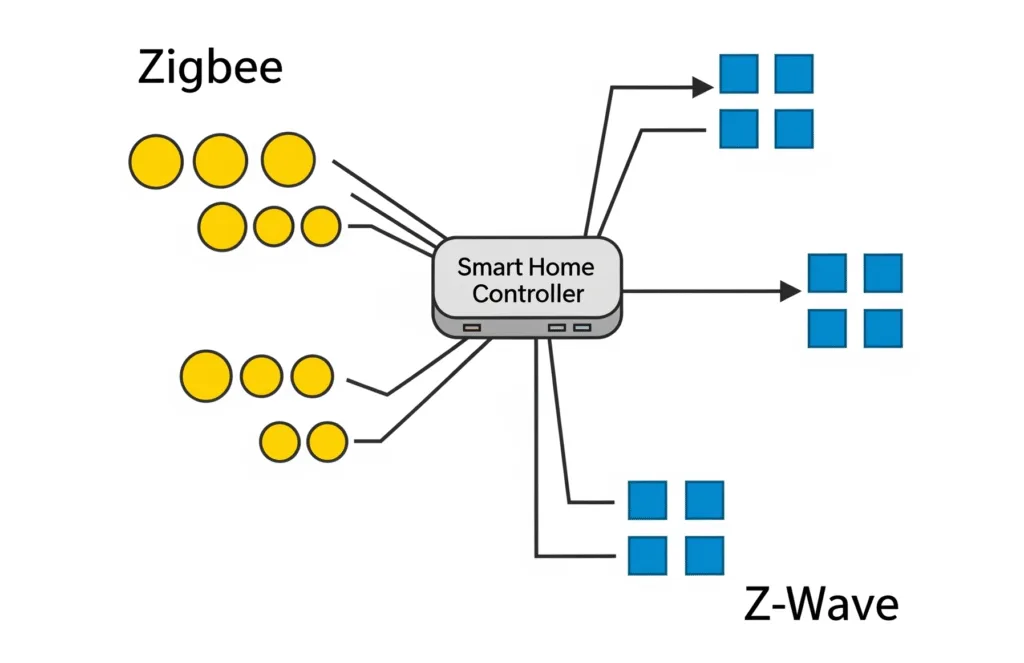
Zigbee forms a mesh network: each device (node) can relay messages to others. This extends coverage and reliability because signals can hop through multiple devices. There is usually a central coordinator or hub that connects the mesh to your router or smart home controller. Thanks to meshing, a Zigbee network can grow very large – thousands of devices can interconnect. For instance, one report notes over 4,700 Zigbee products exist from 400+ manufacturers.
Zigbee is known for its low power consumption. Typical devices draw only a few milliamps when idle, allowing battery-powered sensors or remotes to run for years on a single battery. Security-wise, Zigbee uses AES-128 encryption to protect communications.
Pros of Zigbee
- Low Power: Zigbee devices are very energy-efficient. “Low-power connectivity” is a key advantage, meaning sensors and bulbs can last a long time without frequent battery changes.
- Mesh Networking: Because it’s a mesh, Zigbee can cover large areas by relaying signals through intermediate devices. You can build multi-room networks reliably. One device says mesh “makes it easy to extend the range and reliability of your smart home ecosystem”.
- Large Ecosystem: Zigbee has been widely adopted. Big brands support it (Philips Hue, Amazon Echo, Ikea Tradfri, Samsung SmartThings, etc.). This means lots of compatible devices to choose from.
- Security: Zigbee uses AES-128 encryption, a proven standard for network security.
Cons of Zigbee
- Interference: Because Zigbee typically uses 2.4 GHz, it shares that band with Wi-Fi and Bluetooth. This can cause radio interference or congestion in a busy home, potentially slowing down Zigbee performance.
- Limited Native Range: The range of any single Zigbee radio is modest (around 10–100 meters, line-of-sight). Mesh hops help, but the base range can be limited.
- Speed: Zigbee’s data rate is relatively low (around 40–250 kbps), which is fine for simple commands but not for high-bandwidth data.
- Complex Setup: Some users find Zigbee networks require a bit more technical effort to set up than Matter (which uses QR codes). Pairing Zigbee devices can be less intuitive.
Understanding Z-Wave
Z-Wave is another mature smart home wireless protocol, created in the early 2000s. Unlike Zigbee, Z-Wave operates in the lower sub-GHz band (around 868 MHz in Europe, 908 MHz in the US). This lower frequency means Z-Wave signals penetrate walls and floors better than 2.4 GHz, giving it superior range and reliability in large or complex homes.
Z-Wave is managed by the Z-Wave Alliance (now part of Silicon Labs). It uses a mesh network like Zigbee (with each device acting as a repeater up to 4 hops). A typical Z-Wave network can handle up to 232 devices (new Z-Wave LR supports up to 4,000!). Z-Wave devices are common in security gear, locks, thermostats, and other applications where reliability is critical.
Pros of Z-Wave
- Excellent Range & Penetration: Z-Wave’s sub-GHz frequency penetrates walls ~30% better than 2.4 GHz. Standard Z-Wave can reach ~100m between hops, and the new Z-Wave Long Range (LR) can hit up to 1 kilometer line-of-sight. This makes Z-Wave ideal for large homes or distant devices.
- Low Power: Z-Wave devices tend to consume very little energy. Batteries in Z-Wave sensors often last 5–10 years. (In comparison, Zigbee batteries are usually 1–2 years in similar devices.)
- Stability & Interference Immunity: Because Z-Wave is a single, less-crowded band, it avoids the Wi-Fi interference that Zigbee can see. Many installers praise Z-Wave’s reliability for security systems.
- Backwards Compatibility: The Z-Wave protocol is tightly controlled and certified, so certified devices generally play well together.
Cons of Z-Wave
- Cost & Availability: Z-Wave hardware tends to be more expensive than Zigbee, and fewer manufacturers use it. There are still thousands of products, but the ecosystem is smaller than Zigbee’s.
- Proprietary & Closed: Z-Wave is controlled by Silicon Labs. This means protocol changes and upgrades are centrally managed, and device makers must be certified. (It’s not a fully open standard.)
- Hub Required: Z-Wave devices generally need a Z-Wave controller or hub to work. You can’t just join them to Wi-Fi directly.
- Slower Data Rates: Z-Wave’s maximum data speed is much lower (~9.6–100 kbps) than Wi-Fi or Matter. This is fine for sensors and switches, but it wouldn’t handle video or high-speed data.
- Network Size Limit: Classic Z-Wave caps at 232 nodes. (Z-Wave LR removes this to 4000.)
Matter vs Zigbee vs Z-Wave: Feature Comparison
To clearly see how these protocols stack up, consider this comparison of their key attributes:
| Feature | Matter | Zigbee | Z-Wave |
|---|---|---|---|
| Standard Type | Open IP-based standard at the application layer | Wireless mesh protocol based on IEEE 802.15.4 | Wireless mesh protocol (sub-GHz) |
| Frequency | 2.4 GHz (Wi-Fi / Thread) + Ethernet | 2.4 GHz (global), sometimes 868/915 MHz | 868 / 908 MHz (region-dependent) |
| Range (approx.) | ~50–100m (Wi-Fi) / ~100m (Thread) | ~10–100m per device | ~30–100m (standard), up to 1 km (Z-Wave LR) |
| Data Speed | Up to 250 Mbps (Wi-Fi) | ~40–250 kbps | ~9.6–100 kbps |
| Power Usage | Moderate (varies; Thread is very low) | Low power (good battery life) | Very low power (longest battery life) |
| Mesh Network | Can run on mesh (Thread) or point-to-point | Yes (fully mesh) | Yes (mesh with up to 4 hops) |
| Hub / Gateway Needed | No (Wi-Fi only) / Optional (Thread needs border router) | Generally yes (Zigbee hub or coordinator) | Yes (Z-Wave controller / hub) |
| Interoperability | High (cross-brand) | Limited by brand/hub | Limited (Z-Wave Alliance hubs) |
| Security | AES-128 + PKI-based certificates | AES-128 (standard Zigbee security) | AES-128 (standard Z-Wave security) |
This table highlights why each protocol appeals in different scenarios. For example, Matter stands out for its high data rate and IP backbone, making it great for complex devices (like cameras or TVs) and full cross-brand compatibility. Zigbee shines in massive battery-powered sensor networks due to its low power use, while Z-Wave offers unmatched range and penetration in large homes.
Choosing the Right Protocol: A Step-by-Step Guide
With so much information, how do you pick? Here are actionable steps to decide which protocol (or combination of protocols) best fits your smart home:
- Inventory Your Needs and Devices: List what you have and want. If you already own many devices that speak Zigbee (e.g., Philips Hue bulbs) or Z-Wave (e.g., certain locks), it makes sense to continue in that ecosystem. Otherwise, new homes might lean into Matter for future-proofing.
- Consider Coverage Area: How big is your home? If you need extreme range (outdoor sensors, multi-story), Z-Wave (especially the new Z-Wave LR) is hard to beat. In a smaller apartment, Zigbee or Matter (over Thread/Wi-Fi) will have no trouble.
- Power vs Bandwidth: For battery-only devices (like door sensors), Zigbee or Z-Wave are ideal due to low power use. For high-bandwidth needs (security cameras, streaming devices), Matter over Wi-Fi is better.
- Interoperability Needs: If you prioritize using devices from any brand seamlessly, Matter is designed for that “works everywhere” goal. If most of your smart gadgets are within one ecosystem (for example, all Apple HomeKit or all SmartThings), you might stick with Zigbee/Z-Wave on that platform.
- Hubs and Controllers: Determine your controller. Apple TV or HomePod can serve as a Matter/Thread hub, Google Nest and Amazon Echo likewise. Zigbee typically needs its own bridge (Hue Bridge, SmartThings hub, etc.). Z-Wave absolutely needs a dedicated controller. If you don’t want extra hardware, favor Matter or Wi-Fi devices.
- Budget: Zigbee devices are often cheaper than Z-Wave. Matter devices are just hitting the market and range in price (with more expensive smart displays and cheaper bulbs). Account for the cost of any required hubs.
- Future Expansion: The smart home world is moving towards Matter. Even if you start with Zigbee or Z-Wave, check if those devices can be updated or bridged to Matter in the future. Many future Zigbee and Z-Wave products will be Matter-compatible, meaning your system can evolve.
Ultimately, each protocol has its sweet spot. As one smart home guide advises: “Decide what your priorities are for your home, then consider the specific devices you need, and which protocol will work best for each”. For example, if security and range are your top concerns, Z-Wave (or Z-Wave LR) is likely the winner. If ease of use and brand flexibility matter more, Matter is the future-forward choice. And if battery efficiency is paramount, Zigbee still offers great value today.
FAQs
Q: Will Matter replace Zigbee and Z-Wave?
A: Matter is the next big thing in smart home connections, but it won’t suddenly take over from Zigbee or Z-Wave. All three technologies are likely to work together for a long time. Experts think that companies making Zigbee and Z-Wave devices will probably update their products to work with Matter as well. Matter provides a unified layer, but many current devices will still communicate using older protocols under the hood. As Sonoff’s FAQ summarizes: “There is no single ‘best’ protocol – it depends on your needs. Matter is the most promising for future interoperability, but Zigbee, Z-Wave, and Wi-Fi still have strong use cases”.
Q: What’s the difference between Zigbee and Z-Wave?
A: Zigbee and Z-Wave are both low-power wireless mesh protocols, but they differ mainly in frequency and ecosystem. Zigbee typically runs at 2.4 GHz, which is the same as Wi-Fi/Bluetooth, and offers faster data rates (tens to hundreds of kbps). Z-Wave runs at sub-GHz (868/908 MHz), giving it better wall penetration and longer range (especially with hops). Zigbee has a larger product ecosystem and is vendor-agnostic, while Z-Wave is a more controlled standard with fewer devices but very reliable performance in large setups.
Q: Does Matter need a hub, like Z-Wave does?
A: Not necessarily. Matter devices on Wi-Fi can connect directly to your home router (no extra hub). Matter devices on Thread require a border router (often a smart speaker or hub like HomePod, Nest Hub, or SmartThings) to join the Thread network. But you won’t need a separate protocol-specific hub like you do for Zigbee or Z-Wave. In contrast, Z-Wave always requires a dedicated Z-Wave controller or hub to manage its network. So Matter can simplify hardware if you use Wi-Fi or already have a Thread border router.
Q: Which protocol has the longest range?
A: Traditionally, Z-Wave has had the best range among these, because its sub-GHz radio travels farther with less interference. Standard Z-Wave devices already cover around 100m per hop, and the new Z-Wave Long Range (LR) extension can reach up to 1 km line-of-sight. Zigbee’s range (10–100m) is shorter, and Matter’s range depends on the underlying Wi-Fi/Thread (similar to Zigbee’s for Thread, or up to 50m–100m for Wi-Fi).
Q: Which protocol is better for battery-powered devices?
A: Both Zigbee and Z-Wave are optimized for low power. Z-Wave devices, in particular, boast extremely long battery life (many years) because of their low-frequency, low-data design. For example, a Z-Wave sensor battery may last 5–10 years (versus 1–2 years for a typical Zigbee sensor). Matter (on Wi-Fi/Thread) can also support battery devices, but because Wi-Fi is higher-power, most Zigbee/Z-Wave devices remain more efficient for simple battery sensors. In summary, for a battery-operated sensor network, Zigbee or Z-Wave is still often preferable.
Q: How secure are these protocols?
A: They use strong encryption. Zigbee and Z-Wave depend on AES-128 encryption to keep messages secure. Matter uses AES-128 along with modern certificate-based security, which is based on elliptic-curve technology, for device authentication. In real use, security also relies on regular firmware updates and on how well the encryption is implemented. Matter’s certification and update model is intended to keep devices more consistently secure over time.
Conclusion + Call to Action
In the battle of Matter vs Zigbee vs Z-Wave, there is no one-size-fits-all answer. Each protocol “wins” in different scenarios. Zigbee wins for battery-operated mesh networks and broad device availability. Z-Wave wins for extended range, penetration, and rock-solid reliability in large homes. Matter wins for future-proof interoperability, ease of setup, and integration across all major smart home platforms.
For new smart homes, adopting Matter (especially over Thread) is often recommended to maximize compatibility and security moving forward. However, if you already have many Zigbee or Z-Wave devices, you can continue using them – and leverage bridging hubs that bring them into a Matter ecosystem. The best use case often ends up being all of the above: use Zigbee/Z-Wave devices where they shine (sensors, locks, etc.) and deploy Matter/Wi-Fi devices for new additions needing high bandwidth or cross-platform use.
No Matter which protocol you choose, understanding the trade-offs ensures your smart home runs smoothly. Have you gone all-in on Matter yet, or do Zigbee/Z-Wave networks still power your home? Comment below with your experiences, and feel free to share this guide with friends building their own smart homes. For more on optimizing smart home setups, check out our related posts on smart home hubs, device compatibility, and home automation tips.