
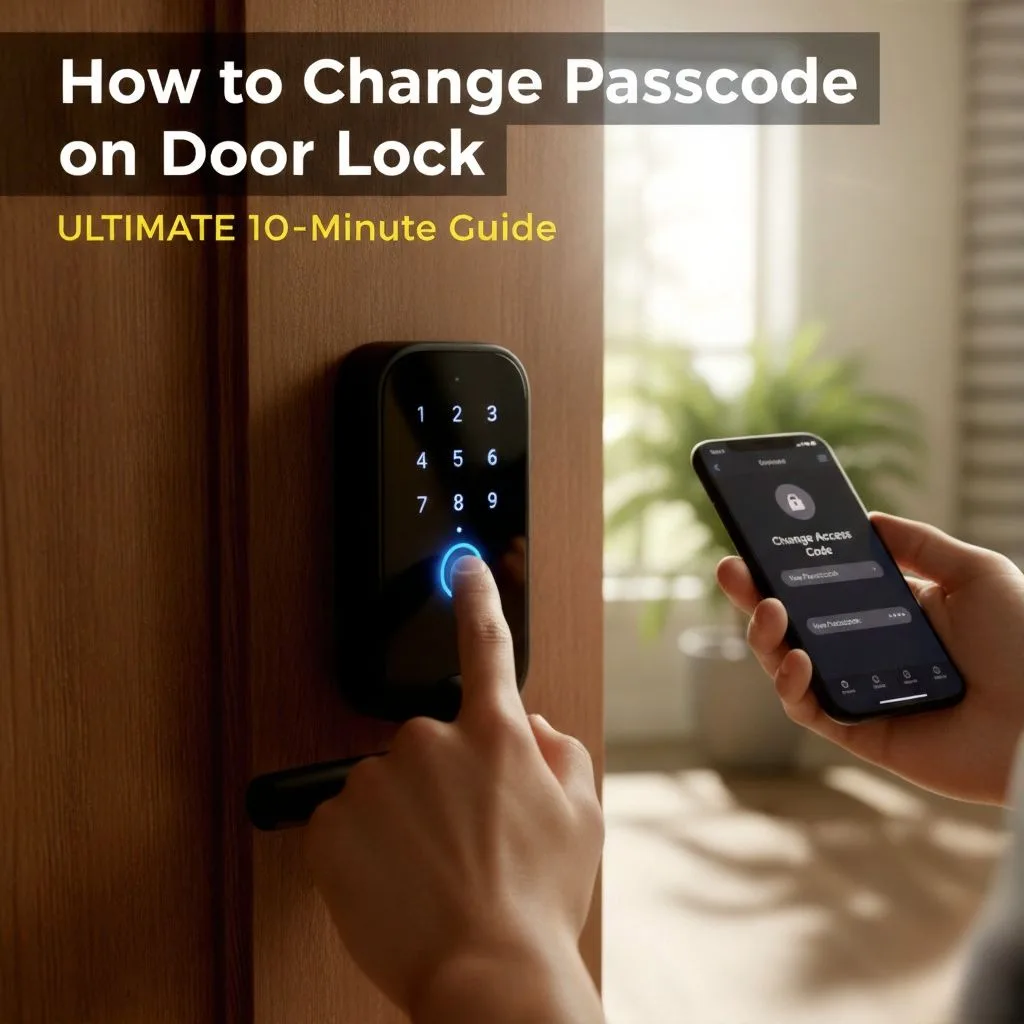
Let’s be brutally honest: when was the last time you actually updated the code on your front door? Seriously, think about it. Was it when you moved in five years ago? Maybe you handed the digits out to a dog walker last year, or perhaps that code is still the one your friendly (but forgetful) contractor used during the renovation. If your door lock code is older than your last phone upgrade, you’ve got a gaping security hole.
That old passcode isn’t just a set of forgotten numbers; it’s a tiny, invisible key that grants instant access to your home, your sanctuary, your castle. You wouldn’t leave a spare physical key under the mat for months, so why trust your peace of mind to an expired digital one? The shocking truth is that even if that code has only been used by one past service provider, it remains active—a ticking time bomb of potential vulnerability. Think about the risk. One simple, repeated code is often the weakest link in an otherwise robust security system.
The good news? You’re here now, and fixing this is simpler than making your morning coffee. Why changing the code regularly is the single easiest way to boost home security cannot be overstated. It’s not about being paranoid; it’s about being proactive. It’s the digital equivalent of changing the locks, only without the headache and the exorbitant bill from a locksmith. This small act immediately improves your security posture.
This is the definitive guide you’ve been waiting for. We are diving deep into the inner workings of modern security to show you exactly how to change passcode on door lock—regardless of the brand—in under ten minutes. We’ll arm you with a comprehensive, human-tested, step-by-step method for the three main types of locks: the ubiquitous keypad, the old-school mechanical chip models, and the modern smart locks. We’ll ensure you can reset door lock code quickly and confidently, turning a stressful task into a simple, ten-minute security upgrade. Let’s roll up our sleeves and reclaim your home’s perimeter.
- Essential Tools and Pre-Program Prep
- Method 1: The Keypad Quick-Change: Master Your Electronic Door Lock Code Change
- Method 2: The Old-School Mechanical Reset: Changing Combination on Door Lock Safely
- Method 3: Updating Your Digital Lock Access Code
- How to Reset Keypad Door Lock FAQs
- FAQs
- Conclusion
Essential Tools and Pre-Program Prep
Before you dive headfirst into reprogramming, a quick reconnaissance mission is in order. Think of this as preparing for a secret agent mission—you need your intel and your minimal gear. The success of your electronic door lock code change depends entirely on this preparation.
The Master Code
The first rule of electronic locks is understanding the hierarchy. You have the Master Code (often called the Programming Code), which is the administrative key, and the User Code (Access Code), which is what you and guests use daily. If you don’t have the Master Code, you can’t program a new User Code. Simple as that. It’s the digital skeleton key.
Where to find it? Check the sticker on the back of the interior assembly (the part facing the inside of your door), scour the original user manual, or, if you’re lucky, look inside the original box. This code is sacred; guard it with your life. If you lose it, you’re stuck with a factory reset, and that’s a headache best avoided. For your sanity, please write it down and store it in a secure, non-digital location, like a safe deposit box.
Essential Hardware for Manual Resets
For the majority of modern electronic locks, you won’t need tools. But for older models and factory resets, it’s always best to be prepared:
- A simple Screwdriver (Phillips or flathead).
- Tweezers (Crucial for the rare, but still existing, chip/pin locks we cover below).
Safety Reminder: Always work with the door open and unlocked. Trust me, learning your new code after locking yourself out is a rite of passage we’d rather you skip. Don’t test fate, test the lock.
Method 1: The Keypad Quick-Change: Master Your Electronic Door Lock Code Change
This method covers the lion’s share of the market—about 90% of the electronic deadbolts currently in service. These are the locks with a standard keypad and a dedicated lock button. This is the simplest electronic door lock code change you can perform, and the one most users search for.
A. The Universal 5-Step Process for Most Keypads
Think of this sequence as a precise digital dance of reprogramming. Speed, accuracy, and listening for the beeps are your allies here.
Step 1: Enter the Programming Code (Master Code)
Input your existing Master Code. This wakes the lock up from its slumber and tells it, “Attention, the administrator is here.” The lock will usually signal its readiness with a couple of quick beeps or a flashing light. The lock is waiting for your next command.
A crucial tip on timing: Electronic locks are easily bored. If you enter the code too slowly—say, pausing between digits—the lock may “time out” and ignore you, forcing you to start all over again. Treat it like a race against an invisible digital clock.
Step 2: Initiate Programming Mode
Now, press the dedicated lock button (it might look like a padlock symbol) or sometimes a specific number like ‘1’ or ‘#’. This is the command to “begin modification.” You should hear a longer series of beeps, and the light should change colour (often amber or a slow red flash). If you hear a series of angry, rapid beeps, you likely entered the Master Code incorrectly—go back to square one.
Step 3: Delete the Old Code (Optional but Recommended)
This is the most critical security step that people often overlook. Just changing the primary code doesn’t always automatically delete existing user codes. Why leave old keys lying around? You must neutralize those old digits.
Check your manual for the exact deletion sequence, but it generally follows this logic: Master Code + Delete Function (a specific key or sequence) + Old User Code + Lock Button. For example, if you gave the cleaning service code ‘9876’, you need to tell the lock to forget it explicitly. Do this, and you’ll sleep soundly.
Step 4: Enter Your New User Code
This is the moment of truth—the code you will use daily. Input the new 4-10-digit code. Now, listen up: avoid lazy numbers. ‘1234’, your birth year, or the last four digits of your phone number are practically shouting your access to the world. Be creative. Be cryptic. After the new code, press the lock button again to register it.
Step 5: Confirm and Test
Wait for the final success signal—usually two distinct, happy beeps and a bright green flash. Now for the non-negotiable step: The Test.
Please close the door, but do not lock it yet. Instead, press the lock button, let the bolt extend, and then try the new code. If it retracts the bolt, you’re golden. Then, and this is important, try the old code. If the old code still works, you need to revisit Step 3 and delete it properly. Testing with the door open is essential because if you lock yourself out, you’re in for a very awkward call to a friend.
B. Branded Deep Dive: Schlage and Kwikset
These two brands are the titans of the residential electronic lock market. They function similarly, but their programming methodologies are as distinct as their logos.
How to Change Passcode on Schlage Door Lock: Touchscreen & Button Models
Schlage locks are renowned for their robust, almost tank-like engineering and simple programming, but they demand precision.
You’ll typically use the dedicated ‘Schlage’ button (the logo) on the keypad to wake the system, and then you’ll enter the 6-digit default programming code. The lock is extremely strict about the length and sequence. If you bought the lock pre-owned, or if a previous owner changed the programming code, you may be stuck searching for the original 6-digit default programming code on the sticker. Without it, you’re forced into the nuclear option: a full factory reset. Schlage is uncompromising on its Master Code security.
How to Reset Kwikset Smart Lock Code: Standard Keypad
Kwikset often makes life easier, relying on physical interaction over complex keypad sequences. On most standard Kwikset keypad models, you don’t even need the keypad for programming! You’ll find a dedicated ‘Program’ button on the interior side of the lock assembly. This is an ingenious feature that prevents outsiders from changing the code even if they somehow got hold of your Master Code.
- Press the ‘Program’ button once.
- Enter the new User Code on the exterior keypad.
- Press the ‘Lock’ button. Done. Simple as that.
Kwikset also includes its patented SmartKey rekeying technology for the physical cylinder. While this is not related to the electronic code, many users confuse the two. If you need to rekey the physical lock to a new key, that requires the SmartKey tool and the new physical key—a completely separate (but equally valuable) security measure. (See our guide on Kwikset SmartKey rekeying here for a detailed walkthrough.)
Method 2: The Old-School Mechanical Reset: Changing Combination on Door Lock Safely
Before touchscreens and Bluetooth, we had a different breed of lock: the mechanical digital lock. These are less common now but still found on older commercial buildings, heavy-duty storage units, or industrial gates. If your lock involves a combination of push buttons and tiny internal brass parts, you’re in this club.
A. The Deconstruction and Recombination Process
This is the most complex way of changing combination on door lock because it requires physical disassembly. It’s a satisfying, almost therapeutic process, reminiscent of a simpler, more tangible time in security technology.
1. Removal is the First Step: Grab your screwdriver. You must safely unscrew and remove the interior half of the lock-set from the door. Keep the screws safe; they often have unique thread patterns. A small magnetic dish is your best friend here.
2. Uncover the Secret: Once the lock is off, you’ll remove the back cover to expose the chip array. Here, you’ll find small pins or chips—usually red chips (coded/active) and blue chips (non-activating/dummies). This is the literal heart of your lock’s security.
3. The Tweezers Task: Using those small tweezers, remove the red chips that correspond to the old code sequence. For example, if your old code was 2-4-6, you’ll remove the red chips from positions 2, 4, and 6. Be gentle; those chips are delicate.
4. Insert the New Code: Now, place the red chips into the holes that match your new desired combination. If your new code is 1-3-5, place red chips into positions 1, 3, and 5. This is literally reprogramming by hand. The blue chips remain where they are, acting as spacers.
5. Reassemble and Verify: Carefully put the backplate and cover back on. Before you screw the lock back onto the door, test the new combination by pressing the numbers. If the lock retracts, congratulations—you’ve completed a physical overhaul!
Method 3: Updating Your Digital Lock Access Code
Welcome to the 21st century! If you have a Wi-Fi or Bluetooth-enabled lock (like Yale, August, or one integrated with a security system), you’re dealing with a different beast entirely. Here, you’re updating your digital lock access code via the smart home ecosystem. This is where security becomes seamless.
A. The Remote Reprogramming Method
The beauty of a modern smart lock is that you rarely have to touch the keypad for management. Your phone is your control panel.
- Open the Ecosystem: Launch the associated mobile app (iOS/Android). Yale, for instance, uses the Yale Access App.
- Navigate to Access/User Management: This section usually has a friendly name like “Guests,” “Codes,” or “User Management.”
- The Key Benefit (The Granularity of Control): This is where the magic happens. Smart locks offer unparalleled control. You can create time-sensitive or single-use codes—for example, a code that only works on Tuesdays between 10 AM and 1 PM for your cleaning service, or a one-time code for a delivery. This level of granular control is the ultimate informational value and a massive security booster. You can delete these codes instantly, remotely, and with zero hassle. It’s like handing out disposable keys.
B. When the App Fails: The Factory Reset Loop
Sometimes, technology gets a little grumpy. The Wi-Fi may be down, or the lock itself is frozen and won’t sync. That’s when you have to resort to the dreaded Factory Reset Loop.
The Nuclear Option: Performing a Full Factory Reset
A factory reset is exactly what it sounds like: it wipes the lock’s memory clean, deleting all user codes, all programming settings, and resetting the Master Code back to the original default. Only do this if all other methods fail.
Generic Steps: This usually involves removing the battery cover, finding a tiny, hidden Reset Button (sometimes labelled ‘R’ or ‘A’), holding it down, and simultaneously reinserting the battery pack. You must hold the button until the lock screams (beeps loudly) and flashes red.
Crucial Warning: This requires you to access the lock, even if it’s app-controlled physically. Check your manual—some locks, like older Yale or Schlage models, require you to remove the lock entirely from the door to reach the reset pin! If you are facing ongoing connectivity issues, consider checking the best practices for Wi-Fi Security and Smart Device Connection.
How to Reset Keypad Door Lock FAQs
Even the smoothest operations hit a snag. Let’s tackle the most common pitfalls when learning how to reset keypad door lock.
A. Common Roadblocks and Quick Fixes
Why Your New Code Won’t Work (The Triple Beep of Doom)
You hear the triple beep. You see the angry red flash. What went wrong? In 9 out of 10 cases, the villain is low battery voltage. Low-power batteries don’t have the juice needed to complete the programming sequence correctly. Always swap in fresh, new batteries (usually high-quality Lithium AAs) before attempting a programming sequence. The other culprit is timing—you need to input the sequence briskly, or the lock will time out and reject the command.
What to Do If You Forgot the Master Code
If you’ve forgotten the Master Code, the first step is to check every label and box for the original default code. If the default code has been changed and lost, the only option left to you is a full factory reset (see Method 3, Section B). This is a stark reminder of why we preach about keeping that Master Code written down and locked away in a safe. Treat it like your password to the kingdom.
FAQs
How can I change the temporary guest code on my Schlage Encode when I’m away from home?
You can change or delete temporary codes remotely using the Schlage Home app, as long as your Schlage Encode is connected to your home Wi-Fi network. Please navigate to the ‘Access Codes’ menu in the app, select the specific guest code, and either edit its digits or delete it entirely. This is instant and key to maximizing your security while travelling.
My Kwikset lock is flashing red after I enter a new code; what should I do to fix this error?
A red flashing light and a fast series of beeps usually indicate that the code you entered is either too long, too short, or is already in use as another user code or the Master Code. Double-check your new code’s length against the lock’s requirements (usually 4 to 8 digits) and ensure you are not accidentally re-using an existing digit sequence.
Can I use the same access code for multiple doors using different electronic locks in my house?
Yes, technically, you can use the same access code across different locks, but it’s highly discouraged for enhanced security. If one lock is compromised or the code is shared, every door becomes vulnerable. It is a much safer practice to utilize unique, complex codes for primary entry points. (For more on layered home security, check out this guide on the Smart Home Council).
Conclusion
We’ve covered the gamut: the rapid digital keypad sequences, the meticulous chip-and-pin overhaul, and the slick app-based controls. By understanding these three main approaches, you are now fully equipped with the knowledge of how to change passcode on door lock for virtually any system on the market. There are no more excuses.
Don’t put this off. That old code is not just inconvenient—it’s a gaping hole in your home security. By dedicating just ten minutes today, you’ve performed a critical, yet often overlooked, security update. Make it a seasonal security habit—change your codes when you change your clocks, or every time you turn over a new leaf. When you hear about those unfortunate, but very real, cases of compromised home security, the simplest failure point is often a stale, easily guessed code. You are better than that.
This is more than just a convenience; it’s peace of mind. Investing in a high-quality electronic door lock—whether it’s a feature-rich smart lock or a dependable heavy-duty keypad—is the best way to leverage modern security technology. It’s a worthwhile investment that not only protects your belongings but also ensures the safety of your family. You deserve a system that adapts as quickly as your life does.
We detailed how 90% of code changes involve Method 1 (Master Code entry, Programming Mode initiation, deleting the old code, setting the new code, and testing while the door is open). For legacy systems, we showed the hands-on chip-and-pin reset, and for modern smart locks, we explained the superior control gained via the mobile app, while providing the steps for the necessary factory reset when all else fails. Remember: fresh batteries and a unique Master Code are your two biggest allies.
Stop relying on that dusty, decades-old security routine. Your house is smart; your security should be too.
Now that you know the how-to, it’s time to upgrade your tech. If your current lock makes programming this difficult, or if you still rely on those fiddly chip-and-pin resets, it’s time for an upgrade. A new generation of electronic deadbolts offers instant, remote programming and audit logs—features that drastically enhance your safety. Click here to explore the best-rated smart and electronic deadbolts that make code changes seamless and instant!. Invest in the ultimate layer of home protection today.