
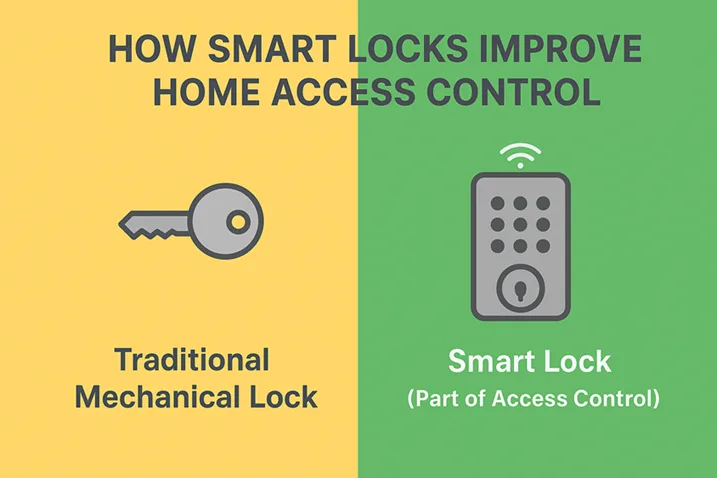
Think back to the old-fashioned key ring: bulky, clinking, and easy to lose. For decades, home entry systems relied on physical keys and mechanical deadbolts. But today we find ourselves stepping into a different era—one where access is managed via smartphones, biometrics and cloud‑based apps. The shift isn’t just about convenience; it’s about how smart locks improve home access control in a meaningful way.
Lost keys, re‑keying cylinders, unauthorized access—these were real headaches. With a smart lock, you gain greater visibility, greater flexibility, and a more connected experience. In short, your front door becomes part of your broader smart‑home ecosystem.
- What Are Smart Locks and Access Control?
- How Smart Locks Improve Home Access Control: Security and Access Management
- The Role of Connectivity and Integration
- User Convenience and Everyday Benefits
- Overcoming Common Concerns
- Smart Locks vs Traditional Locks
- Choosing the Right Smart Lock for Your Home
- The Future of Smart Locks and Home Access Control
- Final Verdict
- FAQs
- Conclusion
What Are Smart Locks and Access Control?
At their core, smart locks are electronic locking devices that operate via digital credentials—mobile apps, PIN codes, key fobs, biometrics—rather than a traditional physical key. These locks typically connect using Bluetooth, Wi‑Fi, Zigbee or Thread (and protocols like Z‑Wave) so they can integrate with other smart home systems.
Access control refers to systems and policies that determine who can enter where and when. In a home setting, that means managing entry permissions, monitoring usage and integrating doors with alarms, cameras or other smart devices. When you combine smart locks with access‑control thinking, you elevate your front door into a managed, monitored point of access. As one article notes: “Whatever solution you choose, it has to let the right people in and keep the wrong people out.”
How Smart Locks Improve Home Access Control: Security and Access Management
Let’s dig into how smart locks deliver real improvements in managing your home’s access control.
Multi‑User Access Control
Imagine you’re a homeowner with regular visitors: cleaners, dog walkers, and extended family. With a smart lock, you can assign each person a unique code, define the time window for access, and revoke it at will. For example, one user on Reddit explained:
“Our Nest/Yale lock allows us to give each nurse their own code and restrict the hours that they can access our home.”
No more hiding spare keys or worrying who has access. This flexibility makes a huge difference for rental homes, shared living situations or family houses with many occupants.
Time‑Based and Temporary Access
Smart locks let you schedule access windows or issue one‑time digital keys. This is handy when you’re away and want to let someone in for a repair, delivery or guest stay. One industry blog puts it this way: you can “eliminate physical keys… automate access workflows.”
Remote Locking & Unlocking
You’re at work, your friend arrives at your house, and you’re not there. No problem: you tap your app, unlock the door remotely, and grant access. This level of control wasn’t possible with traditional locks. One article underscores this benefit: “You’ll never have to worry about locking yourself out again.”
Activity Logs and Visibility
Another powerful upgrade: smart locks can keep a log of who entered when and by what method (code, app, biometrics). This audit trail offers both peace of mind and real operational value. One vendor site writes that you see “exactly when a specific code was used to grant access.”
Advanced Authentication & User‑Experience
Beyond codes, many smart locks support biometrics (fingerprint, face/palm recognition) or proximity unlocking (your phone detects you’re near and unlocks automatically). These features enhance convenience and security. For instance, a blog on Bluetooth smart locks highlights “mobile access… temporary codes… auto-unlock as you approach.”
The Role of Connectivity and Integration
It’s not just about the lock itself—it’s how the lock fits into the broader ecosystem of your home.
Smart Home Automation & Protocol Support
Smart locks that support protocols like Matter, Thread, Z‑Wave or Zigbee integrate into platforms like Google Home, Apple HomeKit, Amazon Alexa, and Samsung SmartThings.
For example, a Chapter in a home‑automation blog said:
“When you leave your home, the smart lock automatically secures the door while your thermostat adjusts and security cameras activate — all in one routine.”
This kind of automation means access control becomes a seamless part of your daily rhythm.
Centralised Access & Unified Experience
When locks, cameras, alarms and sensors tie together, you get one app, one control panel, one ecosystem. Whether it’s a guest code, a maintenance entry, or a camera alert, everything flows through one system. Industry commentary says: “By integrating smart locks into an access‑control system, you extend the feeling of home across your entire property.”
Retrofitting and Scalability
If you want a solution that grows—perhaps into a rental investment, guest house, or multiple doors—smart locks provide scalability. Wireless or connected locks avoid hard‑wiring and complex infrastructure. As one guide points out: “Wireless locking brings together the security of traditional access control with the convenience and scalability of modern technology.”
User Convenience and Everyday Benefits
We’ve talked about features; now let’s talk about what this means for your day‑to‑day life.
- Unlocking with your phone when you’re carrying groceries (no fumbling for keys).
- Granting a visitor access while you’re away—instantly and securely.
- Seeing in your app exactly who entered, at what time, and optionally locking or revoking access minutes later.
- Parents giving kids access without leaving a spare key under the mat.
- Disabled or elderly users can unlock the door easily with biometrics or logging access for caregivers.
- One blog emphasised: “Smart door locks make sharing access easy and secure, with options for temporary or permanent codes that can be revoked at any time.”
From a lifestyle perspective, this is less about tech show‑off and more about returning home with less friction—and more control.
Overcoming Common Concerns
Yes, smart locks are powerful—but they’re not without legitimate concerns. Let’s address them head‑on.
Security and Reliability
Some worry: what if it’s hacked? What if the lock fails? Valid points. But reputable smart locks use strong encryption, two‑factor authentication and physical override (mechanical key or backup). As one security article states: “While the risk of hacking exists just like with other electronics, experts believe the likelihood is very low.”
Power and Connectivity
Because smart locks rely on batteries or wireless connections, you’ll need to monitor battery status and ensure there’s a backup plan (mechanical key or emergency power). Many top models alert you when the battery is low.
Integration and Compatibility
If your smart lock doesn’t play well with your other home devices (or uses a proprietary protocol), you may face fragmentation. Make sure you check compatibility with your existing ecosystem—Matter, Thread, Wi‑Fi, etc. Industry pieces emphasise choosing “solutions that have easy integrations with both software and hardware.”
Cost vs Value
Smart hardware often carries a premium. But when you factor in reduced locksmith calls, lost key replacement, and added convenience/resale value, many homeowners find the long‑term investment justified. A home‑security vendor observes: “The long‑term savings from reduced maintenance costs and increased property value will likely offset the upfront cost.”
By acknowledging these concerns—and showing how to mitigate them—you build credibility and trust with your readers.
Smart Locks vs Traditional Locks
It’s useful to compare the two so readers understand the incremental value.
| Feature | Traditional Mechanical Lock | Smart Lock (Part of Access Control) |
|---|---|---|
| Key management | Physical keys, duplicates | Digital keys, codes, app‑based access |
| Remote control | None | Unlock/lock from smartphone |
| Access logging | No | Event history: who entered & when |
| Guest/temporary access | Difficult | Easy code issuance & revocation |
| Integration with smart‑home | None | Works with cameras, Google Home, etc. |
| Re‑keying after breach | Costly | Revoke digital credentials instantly |
In short: a smart lock doesn’t just replace your deadbolt—it re‑imagines how you control entry to your space. As one comparative review put it: “Smart locks provide solid security for single points of entry … but access‑control systems deliver layered protection …”
Choosing the Right Smart Lock for Your Home
So you’re interested—great. But how do you pick the right one?
- Check compatibility with your ecosystem: Does it support Matter, Thread, or Bluetooth?
- Look at credential flexibility: Can you issue codes, digital keys, or biometrics?
- Consider battery life & backup access: Ideally, get alerts for low battery and a mechanical override.
- Audit logging: Does the manufacturer provide event logs and notifications?
- Integration possibilities: Will it connect with your security camera, doorbell, or smart hub?
- Installation: Is it retrofit-friendly (works with your existing deadbolt) or requires full replacement?
- Companies such as Yale highlight remote access, tamper‑alerts and integration with smart home ecosystems as key features.
Selecting wisely means you don’t just buy a smart lock—you invest in a smarter access‑control layer for your home.
The Future of Smart Locks and Home Access Control
What’s ahead? A few exciting trends:
- Biometric locks and phone‑based digital keys: No key, no code, just you walking up.
- Matter and cross‑vendor interoperability: More ecosystems working together so your smart lock works with any hub.
- AI‑enhanced routines and predictive access: Your system might automatically adjust based on your habits (say, locking when you leave, unlocking when you return).
- Stronger focus on privacy and standards: As adoption grows, the standards will mature, and security will become harder to crack.
- The interplay of convenience, automation and security will push smart locks from “nice‑to‑have” to core home infrastructure.
Final Verdict
In an era where your home should respond to you—not the other way around—a smart lock offers more than a bolt and cylinder. It offers control, clarity and comfort. If you’re ready to make your home more intuitive, more secure and more connected, explore trusted smart lock models today and step confidently into the future of home access control.
FAQs
How do smart locks improve home security and access control?
Smart locks offer digital credentials (apps, codes, biometrics), remote locking/unlocking, audit logs and integration into smart home systems—so you gain much more control than a physical key ever provided.
Can smart locks work without internet or Wi‑Fi?
Yes. Many smart locks support Bluetooth, local passcodes, or embedded processing so they remain functional even if Wi‑Fi is down—though remote features may be limited.
Are smart locks compatible with my existing deadbolt?
Often yes. Some models retrofit into your existing hardware; others replace the whole lock. Be sure to check compatibility, door thickness, and whether you need a hub. (See the “Choosing” section above.)
What happens if the smart lock battery dies?
Most models send low‑battery alerts and include mechanical key override or emergency power contacts so you aren’t left locked out. Regular maintenance helps avoid surprises.
Are smart locks vulnerable to hacking?
As with any connected device, there is a risk. But many smart locks use strong encryption, industry‑standard protocols and physical security testing. The key is to research trusted brands, keep firmware updated, and monitor your system.
Conclusion
By now you’ve seen how smart locks improve home access control in real, tangible ways—not just as tech gadgets but as strategic upgrades for your security, convenience and home‑lifestyle. When you replace physical keys with digital permissions, integrate with your smart‑home ecosystem, and monitor access with clarity, you step into a new paradigm of home entry.
If you’re ready to leap, explore smart lock options that suit your door, your smart‑home system and your access‑control needs. Give yourself the peace of mind that when someone enters your home, you know who, when, and how. Because access isn’t just about opening doors—it’s about controlling the privilege of entering them.
Ready? It’s time to upgrade your lock—and your control.
Check out reputable models from brands like Yale, August and others, read verified reviews, and choose the one that unlocks a smarter home.

thc gummies for calm daily stress management