
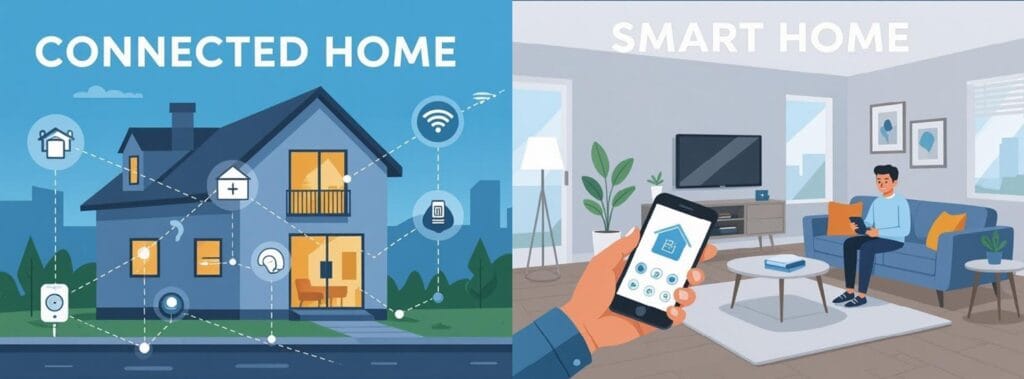
The idea of a “smart home” has grown far beyond controlling devices remotely. Many homeowners are familiar with connected gadgets such as smart bulbs or voice-activated assistants. It’s important to recognize the difference between a connected home and a truly smart home. Users can experience convenience and basic automation of remotely managed individual devices in a connected home. A truly smart home forms an integrated ecosystem in which devices communicate, adapt, and act independently to meet the household’s needs.
Difference Between Connected Home and a Smart Home
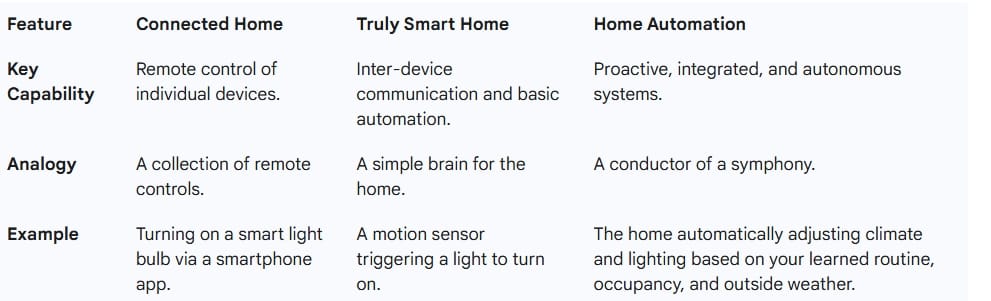
The Connected Home can be analogized to a collection of individual remote controls. Each device, from a smart bulb to a smart oven, has a direct, one-to-one relationship with its user. A person can remotely control these devices via a smartphone app or a voice command. For example, the user can turn on a light from their car or remotely preheat a smart oven so dinner can be started immediately upon arrival. It’s about connectivity and remote access, but the devices function independently of one another.
Gartner defines a connected home as a network that enables the interconnection and interoperability of multiple devices and services, allowing for remote control and monitoring.
The Truly Smart Home is the next evolutionary step. If a connected home is a series of remote controls, then a truly smart home is the brain that operates all of them together. The key differentiator is not just that devices are connected but that they are capable of communication, interaction, and autonomous action. A smart home builds upon the foundational network infrastructure of a connected home. Here, devices work in concert with one another and often with minimal or no human intervention.
The Three Pillars of Smart Home Intelligence
The leap from a connected home to a truly smart one is made possible by three foundational principles that will be explored in detail.
Autonomy and AI: The Brain of the Home
A truly smart home is defined by its ability to perform autonomous, data-driven actions. This moves beyond simple, programmed commands to a more proactive and predictive state. A smart coffee pot turning on at a scheduled time is a basic, timed event. A more advanced, triggered event would be a smart cooling system turning on automatically when the home’s temperature reaches a preset threshold, such as 75 degrees.
The highest level of intelligence, however, is predictive and adaptive. A smart thermostat, for example, uses sensors to learn about daily routines and user preferences, and then alters the temperature based on occupants and weather to save energy. This indicates a change from manual control to the home predicting its own demands, changing technology from a reactive to an active mechanism. Smart devices can also keep an eye on the health of appliances, notifying residents of potential maintenance needs before a failure occurs.
Interoperability and Ecosystems: The Language of Devices
A critical hurdle for consumers has been the technological fragmentation of the smart home market. Smart devices in the past from various brands were restricted to closed “walled gardens,” which made smooth interaction between them almost impossible. For example, a smart bulb from one manufacturer might not be compatible with a hub from another, forcing consumers into a single-brand ecosystem and limiting their flexibility. This lack of interoperability was a major hurdle to wider adoption and a frequent source of frustration for users.
The solution to this problem is a new, unifying standard known as Matter. This protocol is designed to address the “plumbing” of the smart home, allowing devices from different manufacturers to “just work” together reliably and securely. Consumers now benefit from wider choices along with a setup process that is easier and more user-friendly. For manufacturers, the arrival of the Matter standard signals a major shift. Instead of relying on proprietary ecosystems to keep customers locked in, the focus is moving toward innovation built on a common, shared foundation. Companies must set themselves apart through better software, user experience, and unique value-added features rather than relying on hardware exclusivity.
The analysis shows that this shift is profoundly reshaping the market. The real value no longer lies in designing closed systems, but in delivering a richer user experience and enhanced functionality that can work effortlessly with any Matter-compliant device. This distinction is essential for fully grasping the nature of today’s smart home landscape.
The Smart Home Today and Tomorrow: Trends and Practicalities
The Market Is Exploding: Trends & Facts
The smart home market is undergoing an extraordinary period of growth. The global smart home market, driven by a robust compound annual growth rate (CAGR) of 23.1% is valued at USD 121.59 billion in 2024, is projected to surge to USD 633.20 billion by 2032. Within the United States, the market stood at USD 23.72 billion in 2024 and is projected to expand at a CAGR of 23.4% between 2025 and 2030. Alongside this growth, the number of IoT-connected devices worldwide continues to climb, with estimates suggesting it will reach 20.1 billion by 2025.
This growth is not merely a technological trend; deeply human concerns and shifting lifestyles drive it. A growing emphasis on energy efficiency and sustainability is one of the main forces driving this market. Many consumers are turning to smart thermostats and lighting systems to lower utility costs and shrink their carbon footprint. At the same time, security concerns are accelerating adoption, as smart cameras, video doorbells, and connected alarm systems become increasingly popular. The shift toward remote work has also opened up a new avenue of demand. Smart home office solutions are now seen as a necessity rather than a luxury.
In addition, home healthcare is emerging as a pivotal growth particularly in the U.S., where solutions tailored to the aging population are expected to achieve a CAGR of more than 30% between 2025 and 2030. Smart home technologies transform individuals’ lives, work, and manage their well-being.
Getting Started: Cost and Setup
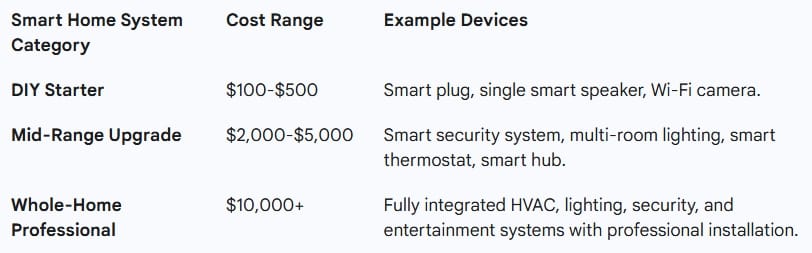
Many consumers are reluctant to use smart home technology because they believe it requires a significant investment. The size and complexity of the system being installed, however, can have a substantial impact on the cost in practice. A basic DIY setup can be built for as little as $100, while a completely customised kit with expert installation can cost more than $10,000.
Typically, homeowners spend between $2,000 and $5,000 on home improvements. It’s also worth noting that expenses continue to grow there, as monthly fees for services like cloud storage or security monitoring can range from $10 to $60, which can have a major effect on the whole budget in the long run.
A Critical Consideration is the Security
Cyberattacks on smart home devices grew by 124% in 2024. These safety concerns are especially alarming for homeowners concerned about security breaches, data theft, and camera access.
The most effective security measure is to create a separate Wi-Fi network for smart devices. This isolates the IoT devices from personal computers and smartphones, ensuring that even if a smart gadget is compromised, a hacker cannot easily access sensitive personal data. Other critical best practices include changing default router and device passwords, enabling two-factor authentication, and regularly updating all device firmware.
The Path Forward: Choosing Your Smart Ecosystem
The Future Is Truly Smart: Your Personalized Ecosystem
The transition from a connected house to a truly smart home is a movement from basic control to personalised intelligence. Future home technology will be simple, integrated systems that develop, change and perform well for the user rather than being a collection of isolated devices. By moving beyond remote control to proactive autonomy and seamless interoperability, a truly smart home delivers on the promise of greater convenience, security, and sustainability.
The Big Three Smart Home Ecosystems
A key decision for any homeowner is selecting a central ecosystem to build their smart home around. The market is dominated by three major players, each with its own strengths and weaknesses. The article will provide a quick comparison to help readers make an informed choice based on their priorities.
Ecosystem Best For Key Features Device Compatibility Data Source
Amazon Alexa: Broad flexibility and third-party integration. Widest range of devices, robust automation with Alexa Routines and Hunches. Extensive, works with a vast array of brands.
Google Nest: Users are already in the Google ecosystem, and those who prioritize strong security. Seamless integration with Google services, sophisticated voice recognition. Extensive, compatible with numerous devices.
Apple Home Kit: Apple users who value privacy and security. End-to-end encryption, local data processing, and deep integration with iOS devices. Limited, primarily to Apple-certified devices.
Frequently Asked Questions (FAQ)
What is the main difference between a connected device and a smart device?
A connected device can be controlled remotely, typically via a smartphone app or voice command, but generally it operates in isolation. By comparison, a smart device has the ability to interact with other devices, gather and process data, and carry out actions automatically based on preset rules or learned behaviors.
How much does it cost to turn a house into a smart home?
The cost can vary significantly, ranging from as little as $100 for a basic DIY setup to over $10,000 for a comprehensive professional installation. The average cost for a typical home upgrade is between $2,000 and $5,000.
What is the most popular smart home device?
Smart entertainment devices, especially smart speakers, currently dominate the market thanks to their broad adoption and ease of use. Other commonly used smart devices include thermostats, lighting systems, and security cameras.
Is a smart home secure?
A smart home security system is fully dependent on how people manage their devices. Although the growing number of connected devices introduces potential concerns, basic security practices such as building an isolated Wi-Fi network for smart devices, using strong passwords, and frequently updating device firmware can considerably reduce these risks.