
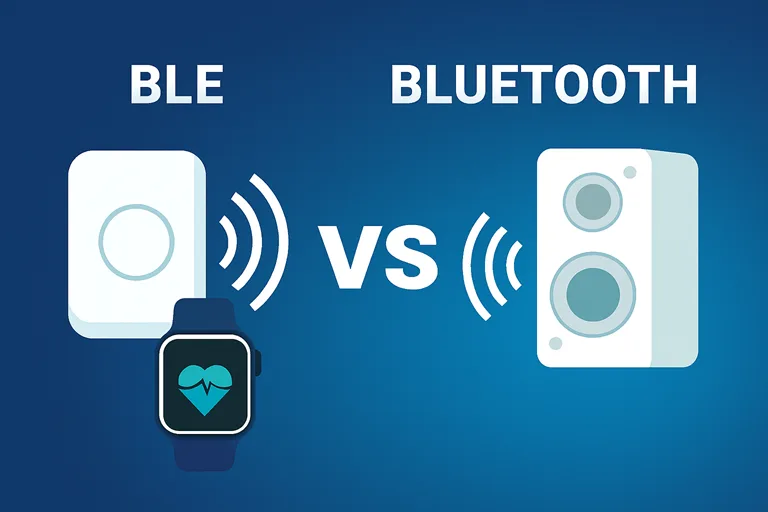
Some smart devices whisper; others shout. Your door lock quietly conserves power for months on a coin cell. Your living‑room speaker, meanwhile, pushes a constant stream of audio without flinching. Both claim “Bluetooth,” yet they depend on different radios to do wildly different jobs. That’s the heart of the debate: BLE vs Bluetooth.
In this guide, you’ll get a clear, practical answer to which technology fits each smart device scenario. We’ll break down what BLE is, how Classic Bluetooth differs, what Bluetooth 5 brings to the table, and where Wi‑Fi beats them both. You’ll also learn how to boost range, tune for speed, harden security, choose the right BT module or BLE module, and when an ESP32 Bluetooth LE gateway makes everything simpler.
To keep this useful and trustworthy, we rely on hands‑on experience and authoritative references you can verify. For foundational details, see the official Bluetooth SIG technology overview. For developer‑friendly chips, explore the ESP32 platform.
Quick verdicts:
- Sensors, beacons, wearables → BLE
- Speakers, headsets, controllers → Classic Bluetooth
- Cameras, video doorbells → Wi‑Fi with BLE for setup
- Mixed IoT gateway → ESP32 Bluetooth LE + Wi‑Fi
- Bluetooth and BLE
- Technical comparison of BLE, Classic Bluetooth, and Bluetooth 5
- Practical use cases and what to pick
- Implementation notes and troubleshooting tips
- Decision framework and checklist for choosing the right radio
- Recommended products to accelerate development
- Frequently asked questions
- Conclusion
Bluetooth and BLE
Bluetooth didn’t start as a single monolithic thing. Over time, it evolved into profiles, stacks, and modes that serve distinct needs.
- What Bluetooth is? A short‑range wireless standard built for device‑to‑device communication. It operates in the 2.4 GHz band using adaptive frequency hopping to avoid interference and maintain robust links. For a concise history, see Wikipedia’s Bluetooth page.
- What year was Bluetooth invented? Bluetooth originated in 1994 at Ericsson and was later standardized by the Bluetooth SIG with broad industry adoption.
- What is BLE? Bluetooth Low Energy is a power‑conscious variant introduced with Bluetooth 4.0. Instead of constant streams, BLE focuses on small, efficient bursts of data. It uses advertising channels to broadcast presence and GATT (Generic Attribute Profile) services to expose sensor data for connected reads/writes.
- Classic Bluetooth, briefly: The “original” Bluetooth supports high‑duty, continuous connections and legacy profiles like A2DP (audio), HFP (hands‑free), and SPP (serial). That’s why it suits speakers and headsets.
- Bluetooth 5 in context: Bluetooth 5 enhances both BLE and Classic. Key upgrades include extended advertising, 2 Mbps high‑speed PHY for BLE, and long‑range Coded PHY. In practice, Bluetooth 5 adapters improve range, stability, and device capacity.
Here’s a tight comparison snapshot:
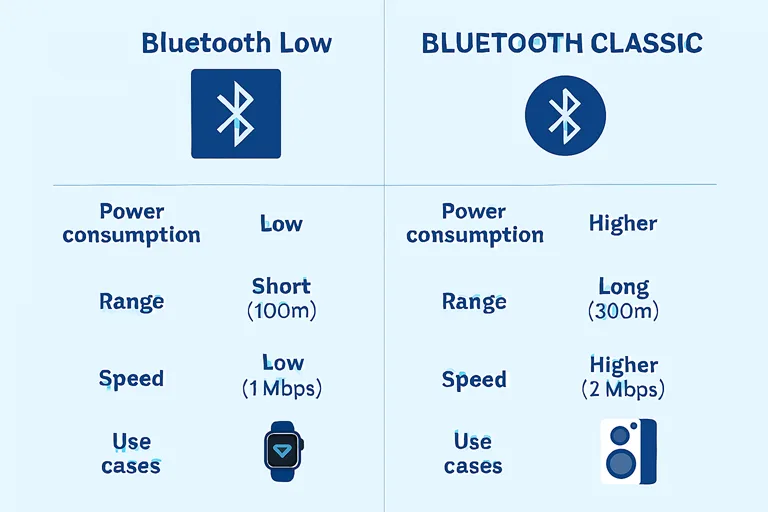
| Attribute | BLE | Classic Bluetooth | Bluetooth 5 additions |
|---|---|---|---|
| Power model | Ultra‑low, bursty | Higher, continuous | Better advertising, long‑range PHY |
| Typical use | Sensors, beacons, wearables | Audio, controllers, legacy SPP | Longer range, faster BLE options |
| Throughput | Up to ~1–2 Mbps PHY | Up to ~3 Mbps | BLE 2M PHY and Coded PHY |
| Pairing | GATT‑centric, flexible | Profile‑driven | LE Secure Connections support |
Sources for deeper reading:
Technical comparison of BLE, Classic Bluetooth, and Bluetooth 5
Radio fundamentals and how data flows
BLE separates advertising from connecting. Devices send signals on specific channels to announce themselves or share small pieces of information. These signals are picked up by scanners, which can then start a connection to exchange data using GATT services and features. This event‑driven approach minimizes radio on‑time, which is how BLE achieves such low energy draw.
Classic Bluetooth leans on profiles over continuous links. It uses Adaptive Frequency Hopping across 79 channels to sustain bandwidth for audio or serial data. Because the radio stays active more often, power draw grows — but so does reliability for steady streams.
Bluetooth 5 strengthens BLE specifically:
2 Mb Bluetooth 5 improves BLE in specific ways:
- The 2 Mbps PHY doubles the BLE symbol rate, allowing for faster data bursts when the signal is strong.
- The coded PHY with S=2 and S=8 sacrifices some speed for better error handling, which greatly increases the range in noisy or blocked areas.
- Extended advertising allows for bigger data packages to be sent without needing a connection, making it useful for Bluetooth beacon tracking.
Power consumption in the real world
BLE is tuned for duty cycles so low that sensors comfortably run months or years on coin cells. By adjusting advertisement intervals (say, 100–1000 ms) and connection intervals (e.g., 30–200 ms), a developer can balance responsiveness with battery life.
Classic Bluetooth, by design, keeps the radio engaged. It’s not inefficient — it’s purposeful for use cases that need unbroken data flow, such as music playback or high‑latency‑sensitive controls.
- Practical takeaway: If your device wakes infrequently and transmits tiny packets (temperature, motion, lock state), BLE wins. If your device must stream with minimal dropouts (headsets, speakers), stick to Classic.
Range and throughput expectations
Radio specs are one thing; application throughput is another.
- Classic Bluetooth range: Typically ~10 meters indoors. Good for room‑scale audio and controllers.
- BLE range: Often 20–50 meters indoors; with Bluetooth 5 Coded PHY, 100+ meters line‑of‑sight is achievable in practical scenarios.
Bluetooth transfer speed varies:
- BLE 1M PHY: Nominal 1 Mbps; app‑level throughput often ~0.3–0.8 Mbps depending on MTU, connection parameters, interference, and stack overhead.
- BLE 2M PHY: Nominal 2 Mbps; app‑level ~0.8–1.4 Mbps with tuned MTU and minimal contention.
- Classic: Peak up to ~3 Mbps; sustained throughput depends on profile, QoS, and link quality.
Tip: Don’t equate PHY rate with file copy speed. GATT overhead, acknowledgements, and retransmissions add friction. For sensors, this overhead is negligible; for large transfers, it matters.
Profiles, stacks, and developer affordances
BLE’s GATT model is elegant for IoT. You define services (e.g., Battery, Heart Rate, Lock Control) and characteristics (values, notifications). Clients discover and interact without the baggage of audio profiles.
Classic Bluetooth leans on pre‑defined profiles:
- A2DP: Audio streaming
- HFP/HSP: Hands‑free/headset
- SPP: Serial data pipe (popular for legacy integrations)
Choosing the right hardware is important.
- For audio devices, you need modules that support Classic Bluetooth with A2DP and strong audio codecs.
- Sensors and beacons work better with Bluetooth Low Energy (BLE) modules that have reliable GATT stacks.
- The ESP32 is a good option since many boards based on it support both types of Bluetooth. An ESP32 Bluetooth LE gateway lets you scan BLE sensors, aggregate data, and forward it to the cloud over Wi‑Fi — a common smart home pattern.
Interference and coexistence with Wi‑Fi
Bluetooth and Wi‑Fi both inhabit 2.4 GHz. Bluetooth uses frequency hopping to dodge interference; Wi‑Fi uses channels with higher duty cycles. In dense apartments or offices, expect contention.
- When to choose Wi‑Fi: If you need sustained megabit‑level throughput or video uplink/downlink, Wi‑Fi is the rational choice. Use BLE for provisioning (onboarding credentials) and low‑power side channels.
- When to choose BLE: For Bluetooth beacon tracking, door sensors, locks, and wearables, BLE’s interference‑resilient hopping and short‑burst behaviour usually deliver excellent reliability without heavy battery costs.
Practical use cases and what to pick
Battery‑powered sensors and beacons
For motion, temperature, humidity, door status, and presence detection, BLE is a home run. Devices advertise small payloads periodically; gateways or phones read them without full connections. This pattern powers Bluetooth beacon tracking in retail and asset tracking in warehouses.
- Recommendation: BLE with modest advertisement intervals (e.g., 300–700 ms) to balance latency and battery life.
- Why: Ultra‑low energy and simple data flows.
Wearables and health devices
Heart rate monitors, fitness trackers, smart rings, and watches gain the most from BLE. Notifications and health metrics are short bursts; BLE’s GATT characteristics map naturally to this data.
- Recommendation: BLE services with notification‑heavy flows and conservative connection intervals.
- Why: Battery longevity and ubiquitous mobile support.
Smart locks and access control
Security matters here. Implement pairing mode only on explicit user action (button press). Use authenticated pairing and LE Secure Connections.
- Recommendation: BLE for lock control, Classic not needed. Harden pairing requires proximity and encrypts state changes.
- Why: Security and battery priorities align with BLE’s model.
Audio speakers, earbuds, and hands‑free
This is Classic Bluetooth territory. A2DP and related profiles are mature, widely supported, and tuned for continuous streams with acceptable latency.
- Recommendation: Classic Bluetooth; ensure aptX/AAC support if your audience values audio quality.
- Why: It’s built for streaming, with broad device compatibility.
Cameras and doorbells
If you’re considering Bluetooth for video, reconsider. Bluetooth isn’t built for sustained video throughput. Use Wi‑Fi for streams; add BLE for onboarding and troubleshooting.
- Recommendation: Wi‑Fi for video, BLE for provisioning (sharing SSID/password securely).
- Why: Throughput and reliability demands exceed Bluetooth’s best‑case.
Edge gateways and IoT hubs
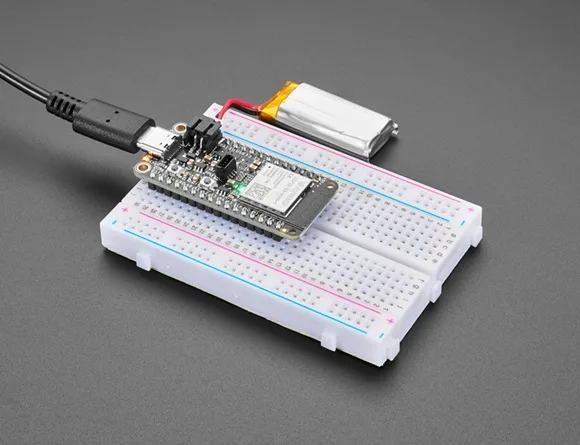
Image Courtesy: https://www.flickr.com/
Combine radios to get the best of each. An ESP32 Bluetooth LE gateway can scan, connect, and manage BLE sensors, while Wi‑Fi handles cloud sync. Add a Bluetooth 5 adapter to your PC or server to improve scan range and device count when building dashboards.
- Recommendation: ESP32 + Wi‑Fi stack for home hubs; Bluetooth 5 dongle for PC‑based gateways.
- Why: Flexibility, range, and development speed.
Asset tracking and indoor navigation
BLE beacons broadcasting IDs, power indoor navigation, and proximity alerts. Gateways triangulate, and analytics compute dwell times and trajectories.
- Recommendation: BLE beacons with tuned Tx power; strategically placed gateways with high‑gain antennas.
- Why: Simplicity, scalability, and low battery cost.
Internal link idea for readers maintaining a documentation hub: If you’re curating onboarding guides, include a definition page for GATT services and characteristics to help developers and writers speak the same language.
Implementation notes and troubleshooting tips
Choosing between the BT module and ble module
Pick modules by use case and compliance, not just price.
- Use case alignment:
- BT module for audio-focused devices like those supporting A2DP and HFP.
- BLE module for use in sensors, locks, wearables, and beacons.
- Regulatory compliance:
- CE and FCC certifications are important as they save time and help with getting approval in the market.
- Antenna quality:
- Using external antennas like SMA or u.FL can greatly improve signal range.
- Make sure to check the antenna’s gain and radiation pattern.
- SDKs facilitate integration with trustworthy and well-documented features, indicating stack maturity. Consistent long-term firmware support is also essential.
- Ecosystem for development – Examine the tools, community assistance, and example code.
- Espressif, Nordic (nRF52), and Silicon Labs provide robust development ecosystems.
External resources to compare modules:
How to increase Bluetooth range without guesswork
Range tuning blends physics, placement, and protocol choices.
- Antenna placement:
- Bold principle: Keep antennas away from metal, large batteries, and ground planes that detune them. Elevate and orient for line‑of‑sight where possible.
- Use Bluetooth 5 Coded PHY:
- If both ends support it, long‑range modes trade speed for robustness — ideal for sensors.
- Increase Tx power (within legal limits):
- Many modules allow adjusting the transmit power, respecting regional regulations.
- Optimise gateway density:
- Place gateways centrally and high. Avoid dead zones (e.g., behind fridges, near microwaves).
- Channel coexistence with Wi‑Fi:
- Separate Wi‑Fi access points from Bluetooth hubs physically. Use 5 GHz Wi‑Fi for high‑bandwidth devices to reduce 2.4 GHz congestion.
- Consider mesh:
- BLE Mesh enables relay‑style coverage expansions without brute‑force Tx power increases.
Speed tuning and transfer reliability
Bluetooth transfer speed depends on more than PHY rates.
- Increase MTU size:
- Larger MTU reduces per‑packet overhead for bulk GATT transfers.
- Tune connection interval and supervision timeout:
- Shorter intervals: lower latency, higher overhead.
- Longer intervals: better battery, lower responsiveness. Choose based on UX needs.
- Batch packets intelligently:
- Send updates in bursts when the radio is already awake; avoid waking the radio for single crumbs.
- QoS mindset:
- For audio (Classic), keep link margins healthy. For sensors (BLE), favour reliability (ACKs) over raw speed.
- Profile selection:
- Don’t force SPP on BLE. Use GATT properly with notifications/indications.
Security best practices and pairing modes
Is Bluetooth secure? It can be — with modern settings and discipline.
- What is pairing mode:
- A controlled condition in which the device is discoverable and allows for secure bonding (key exchange).
- To minimize attack windows, trigger this using a physical button or an app command.
- Prefer LE. Secure connections: For sensitive devices (locks, health), use authenticated pairing techniques (passkey entry, numeric comparison).
- Avoid legacy fallbacks: Disable insecure pairing modes and obsolete cipher suites whenever possible.
- Firmware Hygiene:
- Sign updates and validate during installation.
- Patch vulnerabilities rapidly.
- User feedback loops: Provide obvious signs of when a device pairs and reconnects (LED, app prompts). This avoids quite compromises.
The Bluetooth security architecture contains information on specific standards.
ESP32‑specific tips for BLE and coexistence
The ESP32 Bluetooth LE platform is popular for gateways and prototypes.
- Dual‑mode radio:
- ESP32 can run BLE and Wi‑Fi together; tune task priorities and allocate buffers carefully to prevent starvation.
- Scanning strategies:
- Use window/interval settings to balance discovery responsiveness and CPU/RAM use.
- GATT roles:
- The device can act as a central (scanner/controller) or peripheral (sensor). Gateways typically act as centrals.
- Provisioning pattern:
- Use BLE to deliver Wi‑Fi credentials securely; then switch data traffic to Wi‑Fi for throughput.
- Resources:
- Start with the ESP-IDF BLE guide and community examples.
Decision framework and checklist for choosing the right radio
When choices feel fuzzy, run through this fast checklist:
- Define the use case:
- Battery life first? → BLE
- Continuous stream? → Classic Bluetooth
- High‑bandwidth or video? → Wi‑Fi
- Throughput requirement:
- Under ~100 kbps sustained: BLE is ideal.
- ~0.5–2 Mbps bursts: BLE 2M PHY with careful tuning.
- 1+ Mbps sustained: Classic Bluetooth or Wi‑Fi.
- Range requirement:
- Room‑scale: Classic or BLE 1M.
- Whole‑home/warehouse: BLE Coded PHY, good antennas, more gateways.
- Security posture:
- Require pairing mode on user action, LE Secure Connections, authenticated pairing, and firmware signing.
- Prototyping plan:
- Use an ESP32 dev board for mixed BLE/Wi‑Fi functions. Add a Bluetooth 5 adapter to your PC for better scanning.
Decision matrix (device → recommended radio):
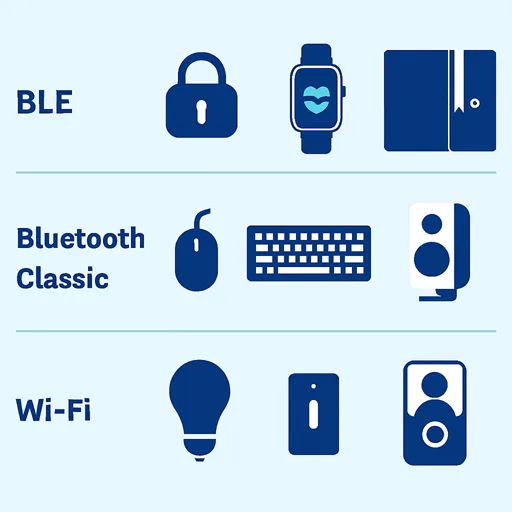
- Lock, sensor, wearable: BLE
- Speaker, headset, controller: Classic Bluetooth
- Camera, doorbell: Wi‑Fi (+ BLE for setup)
- Gateway, hub: ESP32 Bluetooth LE + Wi‑Fi
Recommended products to accelerate development
- ESP32 Development Board (BLE + Wi‑Fi):
- Ideal for prototyping gateways and sensors.
- External link: Espressif ESP32 products
- Bluetooth 5 USB Adapter:
- Increase range, improve scanning, and support modern features.
- External link: Bluetooth 5 adapters on Amazon
- BLE Beacon Modules:
- Ready‑made beacons for trials in retail or warehouses.
- External link: MokoSmart BLE beacons
If you run a documentation site or blog, internally link device guides (e.g., “How to provision Wi‑Fi over BLE on ESP32”) to improve trust and reader flow.
Frequently asked questions
Conclusion
If you’re still weighing BLE vs Bluetooth, remember the simplest rule: choose the radio that matches the rhythm of your device. Sensors and locks whisper; they thrive on BLE. Speakers and headsets sing; they need Classic Bluetooth. Cameras and doorbells stream; give them Wi‑Fi and let BLE handle setup.
Now turn insight into action. Get hands‑on with a flexible platform and modern adapter:
- Build and test with an ESP32 dev board: It’s a powerhouse for BLE + Wi‑Fi prototyping.
- Explore: Espressif ESP32 products
- Upgrade your gateway with Bluetooth 5: Better range, stability, and device capacity in minutes.
Start small: deploy one BLE sensor, connect it to your ESP32 Bluetooth LE gateway, measure battery life and real‑world range, then iterate. Your smart devices will feel more reliable, more secure, and more human — exactly how a modern home should be.
Ready to make your smart home smoother and more resilient? Click to grab a Bluetooth 5 adapter today and unlock longer range and cleaner connections out of the box.