
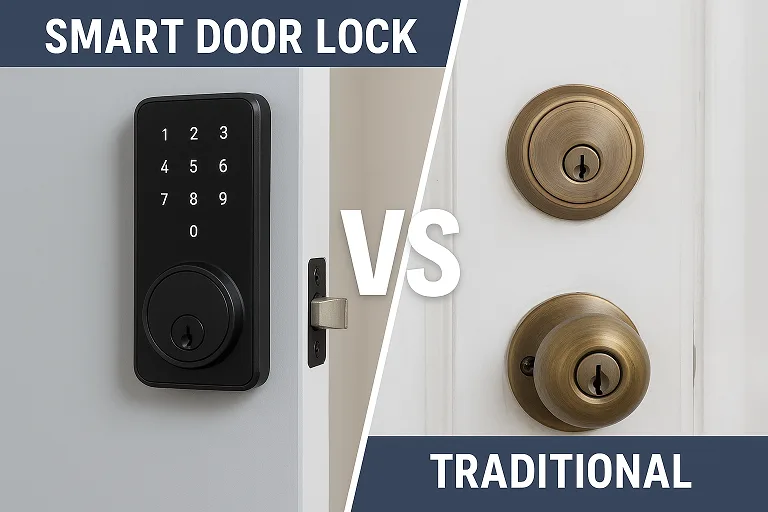
When you walk up to your front door and reach for the key, you might pause and ask: Is this how it’s always going to be? In an age when your phone unlocks the car, maybe even the lights, it’s fair to wonder whether the humble mechanical lock is still the best guard for your home. Enter the smart door lock, promising keyless convenience, remote control, and even guest access with a tap of your thumb—or so the marketing goes. But hold on: before you rip out your traditional lock and install the latest gadget, it’s worth stepping back, comparing smart vs. traditional, and asking which one you should choose.
In this article, we’ll explore both types of locking systems: from how they work, to their strengths and weaknesses, to installation, cost, reliability, and real-world use cases. By the end you’ll be equipped to make a confident decision: should I upgrade to a smart lock or stick with a traditional one?
- What Are Smart Door Locks and Traditional Locks?
- Security Comparison: How Do They Truly Measure Up?
- Convenience and Accessibility: Everyday Use in Real Life
- Reliability and Power: When Technology Meets Reality
- Installation, Compatibility and Maintenance
- Cost and Value Over Time: Upfront vs Long-Term Investment
- Integration with Smart Homes and Modern Living
- Who Should Choose Which?
- FAQs
- Conclusion
What Are Smart Door Locks and Traditional Locks?
Traditional locks
At its core, the classic deadbolt or lock + key mechanism has been around for decades. When you insert a key and turn, driver pins align within a cylinder and the bolt slides into the frame, securing the door. No battery required, no app update, no connectivity negotiation. Simple, proven, dependable.
Smart door locks
On the flip side, a smart door lock is essentially a mechanical or electromechanical bolt plus an electronic module that enables remote or digital access: smartphone apps, Bluetooth or Wi-Fi connectivity, keypad access, fingerprints, or voice commands. In other words: the bolt still does the job, but you gain a host of extra features.
That distinction is critical: you are still depending on the physical lock—but you add a layer (or several) of connectivity, electronics and software. With that extra layer come both potential benefits and new responsibilities.
Security Comparison: How Do They Truly Measure Up?
Physical security
Traditional locks constrain intruders through simple mechanical resistance. High-quality deadbolts can satisfy industry ratings for durability and strength. For example, the Schlage brand notes that even their smart locks use the same physical hardware and are BHMA AAA rated. That shows traditional mechanics are still robust.
But here’s the twist: smart locks can add features like tamper alarms, sensors for lock-jamming, and remote lock/unlock monitoring. According to Schlage, smart models bring additional safety features in the “lock security” category. So if you’re comparing strictly bolt strength, both can be good—but smart adds extra control.
Digital vulnerabilities
A traditional lock can’t be hacked—no software, no firmware update, no bug to exploit. That’s a strength. Conversely, smart locks are network-enabled devices: they may use Bluetooth, Wi-Fi, Z-Wave, or other protocols. If not configured properly, they could become an access vector.
While cybersecurity risk exists, that doesn’t mean smart locks are weak—many do use encryption, and professionals agree: “Yes, smart locks are safe.” The key is how they are set up, maintained and used.
The security verdict
Here’s the takeaway. If your concern is “can it keep someone out regardless of technology,” a well-installed traditional lock remains a solid baseline. If your concern is “can I monitor, manage, and grant access in flexible ways,” and you’re willing to manage batteries, updates and network hygiene, then a smart lock may offer stronger overall security experience. In short: it’s not simply traditional vs smart—it’s about environment + user discipline.
Convenience and Accessibility: Everyday Use in Real Life
Let’s be honest: part of the smart lock appeal is plain old convenience.
With a traditional lock, you carry a key. Fumble when your arms are full of groceries. Dig around in your pocket or bag for the key. With a smart lock, you might use your smartphone, a fingerprint, a keypad, or even scheduled access codes. Open the door hands-free when the kids bolt out, or unlock remotely for the cleaner arriving at 2 pm.
For some users, this is a game changer. Imagine you’re on vacation and someone comes to fix your plumbing: send them a code instead of hiding a key under a mat. Smart locks support this. Traditional locks? Less flexible: you hand over a key (and hope you get it back).
But convenience carries trade-offs. What if your phone dies? What if firmware glitches? What if battery runs out? Conventional locks don’t ask “is your app connected?”
If you value ease of access, remote control and integration with other smart-home systems, the smart lock wins. If you prefer the simplicity of “insert key, turn, done,” a traditional lock has its charms.
Reliability and Power: When Technology Meets Reality
A smart lock is only smart if it’s powered and connected (or at least has fallback systems). Many models run on batteries, and some offer mechanical override keys. If you skip the maintenance or your firmware goes haywire, that convenience turns into frustration. According to locksmith-industry users, smart locks in residential use may fail sooner due to electronics and alignment issues. In contrast, traditional locks, when installed properly, can last decades with minimal fuss: occasional lubrication and key duplication.
Consider scenarios: a power outage (smart locks often still work on batteries or emergency backup), extreme weather (electronics may struggle), or misalignment of door due to settling (mechanical locks face similar issues but fewer components to fail). If you live in a remote area with poor connectivity, dependability may tilt toward the traditional.
In short: smart locks bring extra features—but also extra dependencies. Traditional locks give fewer features but higher reliability under many conditions.
Installation, Compatibility and Maintenance
Installation
Installing a traditional deadbolt is straightforward if you’re replacing one. No network setup, no app to download. Smart locks may require additional steps—matching the bolt, pairing with the network, configuring access codes, integrating with smart-home platforms. Some are DIY; others may benefit from pro installation.
Compatibility
If you already have a smart-home ecosystem—say Apple HomeKit, Google Home or Amazon Alexa—a smart lock can integrate nicely. The brand Schlage offers models that work with Apple Home Keys and mobile tap unlocking. Traditional locks don’t integrate—they simply lock.
Maintenance
Smart: Check battery ~ every 3-6 months depending on use. Firmware updates. Connectivity tests. Traditional: Occasionally lubricate, ensure bolt alignment, duplicate keys if needed. Many users underestimate how convenient it is to not worry about software updates.
For renters, compatibility matters too. If you rent and have to remove a lock later, a traditional lock may be easier to swap without damage or app re-configuration.
Cost and Value Over Time: Upfront vs Long-Term Investment
Let’s talk dollars. Traditional locks often cost between US $30–$80 for a good deadbolt, plus perhaps a bit for installation if you use a locksmith. Smart locks typically start around US $150–$400 or more depending on features (Wi-Fi, biometrics, brand).
But that’s just initial cost. Over time, smart locks may avoid hiring a locksmith when you lose a key, or may offer automation that adds convenience. Traditional locks have fewer features and may require key duplication or re-keying when you move or lose keys (that cost adds).
Some smart-lock proponents argue the value is in the features: remote access, guest codes, integration with home systems. But the alternative: you may pay for features you rarely use.
Value is therefore context-dependent. For a tech-savvy homeowner who values remote control and integration and doesn’t mind occasional maintenance, the smart lock may pay off. For a homeowner or renter who prioritizes simplicity, budget, and minimal fuss, a traditional lock may deliver better “bang for buck.”
Integration with Smart Homes and Modern Living
One of the most compelling arguments for smart locks is how well they mesh with a connected home. Picture this: you arrive home, your smart door lock recognizes you, unlocks the door, your hall lights turn on, thermostat adjusts, and your camera registers that it’s you pulling in. All seamless automation.
Brands talk about access logs, temporary guest codes, and remote lock/unlock from smartphone. According to Yale’s overview of smart door locks, you can even grant time-limited access to guest service providers and get alerts when the door is unlocked.
Traditional locks don’t integrate. They are standalone. That’s not a fault—just a limitation. If your home doesn’t have a smart-home ecosystem, the extra value of a smart lock may be under-utilized.
Another angle: privacy and data. With smart locks you are trusting not just a bolt—but a networked device that may log your comings and goings. Some users worry about what data is collected, how secure the backend is. The old-school lock doesn’t phone home. If you care deeply about minimizing digital trace-points, the traditional lock might feel more “private.”
Who Should Choose Which?
Let’s tailor it to you. Different lifestyles and needs tilt the recommendation one way or the other.
- Homeowners with a smart-home ecosystem: If you already use voice assistants, smart lighting, home automation, then a smart door lock can be a seamless extension. You’ll get real benefit from remote access, guest codes, integration.
- Frequent travellers / Airbnb hosts / service-provider scenarios: If you regularly let others in when you’re not home, want remote control of who has access and when, then a smart lock offers real advantage.
- Renters / minimal-tech lifestyle: If you move often, prefer plug-and-play, have limited smart-home devices, or simply want a lock that works no matter what, then a quality traditional deadbolt might be the better choice.
- Older adults / technophobic users: If complexity is a concern, or if you want something low-maintenance with no apps, batteries and firmware, a traditional lock may win.
Decision-flow mini-table (just for clarity):
| User profile | Best choice | Key reason |
|---|---|---|
| Already have smart-home gear | Smart lock | Full integration and remote functions |
| Need guest access remotely | Smart lock | Temporary codes, remote unlock |
| Prefer minimal tech, budget | Traditional lock | Low cost, no batteries, no app |
| Renters / frequent moves | Traditional lock | Lower investment, simpler install |
As you ponder your choice, keep this in mind: Even the best lock only does its job if properly installed, upgraded (in smart-lock cases), and used wisely. The strongest physical lock is meaningless if the door frame is weak.
FAQs
Are smart locks more secure than traditional locks?
Not inherently always—but they can offer stronger overall control when used properly. While traditional locks don’t have digital vulnerabilities, they also don’t offer remote monitoring or access logs.
What happens if the smart lock battery dies?
Many models provide mechanical override keys, emergency power terminals, or remote unlock via app. But yes—power dependency is a new factor. You’ll want to check backup options.
Can smart locks be hacked?
Theoretically yes; as one security expert put it: “Unlike breaking key codes, … a smart lock can theoretically be attacked remotely.” However, reputable smart locks use strong encryption, regular firmware updates, and secure manufacturing—so the risk is manageable. Good setup matters.
Do smart locks work without Wi-Fi?
Some smart locks use local Bluetooth or keypad access and don’t require Wi-Fi for basic functionality—though remote control will need connectivity. Always check the model’s specifications.
Are traditional locks becoming obsolete?
Not yet. Traditional locks remain effective, reliable and cost-efficient. They are far from obsolete—but for certain users and environments, smart locks offer clear incremental value.
Conclusion
So: boldly stated—there’s no universally “better” option. The right choice between a smart door lock vs traditional lock depends on you: your home, budget, habits and comfort with technology.
If you’re tech-savvy, value convenience, remote control and guest access, and you already live in a connected home, the smart lock offers not just a gadget upgrade, but a genuine upgrade in functionality. If you prefer simplicity, minimal fuss, and want peace of mind without worrying about firmware or batteries, a proven traditional lock holds its ground.
At the end of the day, security isn’t just about hardware—it’s about how you use it. Whether you choose smart or traditional, install the lock properly, maintain it, use strong habits (don’t leave keys under the mat, keep software updated, monitor access codes), and your door will do its job.
If you’re ready to explore specific models and features, consider checking out smart lock options like the Schlage Encode Plus or budget-friendly models from leading brands, and compare them side-by-side with high-quality deadbolts. Evaluate installation ease in your setting, compatibility with your door, and long-term value.
Your next step? Identify your budget, your lifestyle needs (guest access, integration, travel) and decide whether the extra technology suits you. Once decided—install confidently, test it thoroughly, and sleep soundly knowing you locked your door right.
Ready to upgrade your home security? Whether you stick with a rock-solid deadbolt or step up to a connected smart lock, commit to making it work for you—and treat it less as a gadget and more as your first line of defense. Choose wisely, install well—and flip that lock for peace of mind.
Dive into trusted reviews of top smart lock models and compare installation guides today—your front door is worth more than just a key.