
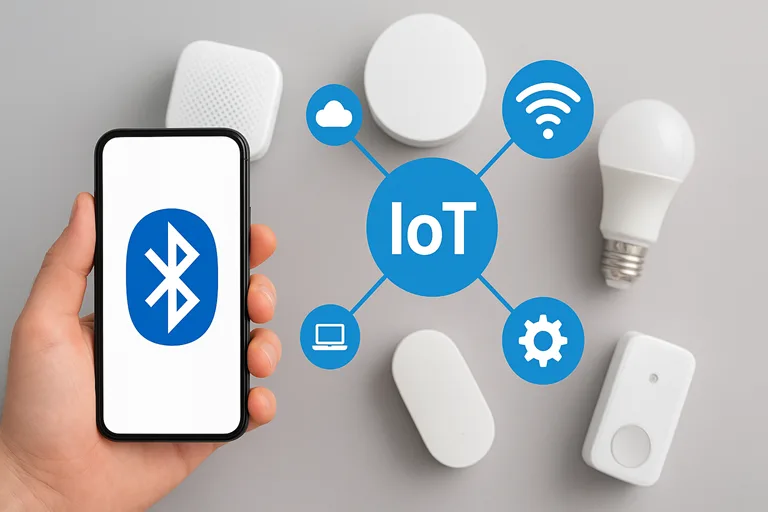
There’s a quiet revolution happening in pockets, pockets of pockets: sensors tucked under store shelves, tiny tags on shipping pallets, wearables that know your heartbeat before you do. At the core of many small miracles sits a deceptively simple technology—Bluetooth in IoT. It’s not flashy. It doesn’t require fiber or towers. What it offers, in plain terms, is practicality: low power, universal reach (through phones), and steadily improving protocols that scale from a lone thermostat to whole-building lighting networks.
In this piece, I’ll take you on a journey: from Bluetooth’s evolution, through its low-power magic (BLE), into the realm of Bluetooth Mesh, and onward to real-world use cases, security considerations, comparisons with rival standards, and a roadmap for implementing your own network. By the end, you’ll understand not only why Bluetooth matters, but how to make it work in your IoT projects.
- Bluetooth in IoT— A Brief Overview
- Evolution of Bluetooth Versions & Key IoT Features
- Why Bluetooth Low Energy IoT Is a Cornerstone for Low-Power IoT
- Bluetooth Mesh Explained — Topology, Message Relay, Provisioning, and Trade-offs
- Key IoT Use Cases of Bluetooth
- Security, Reliability, and Coexistence
- Bluetooth vs Zigbee vs Thread vs Wi-Fi — A Decision Matrix for IoT Connectivity
- Implementation Checklist & Recommended Chips / SDKs
- Ambient IoT, PAwR, and Beyond
- The Big Picture
- Current Trends and Future Directions
- Real-World Applications and Case Studies
- FAQs
- Executive Summary, Hook, and Call to Action
Bluetooth in IoT— A Brief Overview
Bluetooth began life as a cable-killer—an elegant wireless substitute for RS-232 and the headphone jack. Over the decades, it mutated from that modest mission into a toolkit for connectivity. The tectonic shift arrived with Bluetooth Low Energy (BLE) around the Bluetooth 4.0 era: an intentionally frugal radio designed for devices that send tiny, infrequent packets and then sleep for long stretches. Later, Bluetooth 5.x expanded reach, improved advertising payloads, and paved the way for higher throughput and more robust coexistence in crowded radio spaces.
Then came Bluetooth Mesh, designed to let devices relay each other’s messages in a many-to-many topology—ideal for smart lighting, distributed sensor grids, and industrial sensors that must span large areas without centralized controllers. Taken together, these developments drove Bluetooth from handset peripheral into a core IoT connectivity option.
Evolution of Bluetooth Versions & Key IoT Features
Every successive version of Bluetooth adds key capabilities for connectivity, energy efficiency, and data integrity, reflecting the Internet of Things’ ever-increasing demands. A high-level timeline of important technological advances related to the Internet of Things is presented below.
| Bluetooth Version | Year | Notable Features for IoT |
|---|---|---|
| 1.0/1.1 / 1.2 | 1999-2003 | Basic wireless connectivity; initial challenges with interoperability |
| 2.0 + EDR | 2004 | Enhanced Data Rate (EDR—up to 3 Mbps), reduced power, faster pairing |
| 3.0 + HS | 2009 | High Speed; optionally uses Wi-Fi for data transfer up to 24 Mbps |
| 4.0 (BLE) | 2010 | Bluetooth Low Energy (BLE); multi-year battery life; smaller, simpler devices |
| 4.1/4.2 | 2013-14 | Improved coexistence and privacy; 6LoWPAN/IPv6 support; larger packets |
| 5.0 – 5.4 | 2016-23 | 2x Speed (2 Mbps), 4x Range, 8x broadcast capacity, mesh networking, beacons, improved location services (direction finding), periodic advertising |
| 6.0 | 2024 | Channel Sounding, enhanced filtering, decision-based advertising, audio capabilities, frame space update, greater reliability for advanced IoT scenarios |
Real-world IoT deployments are closely mirrored in Bluetooth’s rising trend, which includes improving interoperability across devices and ecosystems, improving battery consumption for medical wearables, and increasing speed and range for industrial sensors.
Bluetooth Device Classes
Understanding device classes is essential for optimizing range and power consumption in your IoT rollout:
- Class 1: 100 mW, up to 100 meters (industrial/large area)
- Class 2: 2.5 mW, up to 10 meters (typical for consumer electronics)
- Class 3: 1 mW, up to 1 meter (short-range/specialized use)
Why Bluetooth Low Energy IoT Is a Cornerstone for Low-Power IoT
If you’re designing battery-operated sensors, power is the currency. BLE’s architecture is deliberately parsimonious: devices linger asleep, wake just long enough to speak, and return to a near-zero power state. This is why so many wearables, beacons, and simple environmental sensors run months—or even years—on tiny cells.
- Energy efficiency: BLE’s event-driven model reduces average current draw drastically, enabling coin-cell operation for many sensors.
- Cost & commoditization: BLE SoCs and modules are mature and inexpensive—good news for scaling hardware.
- Ubiquity: Smartphones and tablets act as natural gateways, so many devices don’t need dedicated infrastructure to reach the cloud.
- Flexible modes: BLE supports point-to-point, broadcasting (advertising), and mesh—choose the mode that fits your device’s role.
- Mesh Networking: Bluetooth mesh extends communication beyond point-to-point, supporting large, scalable, self-healing device networks spanning hundreds or thousands of nodes.
- Security: Strong, native encryption and advanced authentication measures meet the escalating security and privacy needs of IoT deployments.
- Indoor Location and Proximity: BLE beacons empower accurate asset tracking and contextualized user experiences—without draining device batteries.
These properties make Bluetooth IoT a pragmatic first choice for low-data, energy-sensitive deployments such as indoor beacons, wearable health monitors, and smart home sensors. For an authoritative industry perspective on this evolution and the concept of ambient, sensor-rich environments, the Bluetooth SIG’s Ambient IoT materials are a useful reference.
Optimizing BLE Energy Consumption
Battery life and responsiveness are balanced in an efficient BLE architecture. Reducing power consumption can be accomplished by:
- Sleep modes and duty cycling
- Adjusting the duration of advertisements and connections n intervals
- Leveraging features like peripheral latency (letting a device skip connection events if it doesn’t need to send data)
- Data length extension, allowing efficient high-volume data transfer when needed
- Choosing optimal transmit power and using adaptive frequency hopping to avoid interference.
BLE beacons in retail that last years wearables recording health data for months, and asset tracking sensors in logistics, when battery replacement is expensive or unfeasible, are all real-world examples.
Bluetooth Mesh Explained — Topology, Message Relay, Provisioning, and Trade-offs
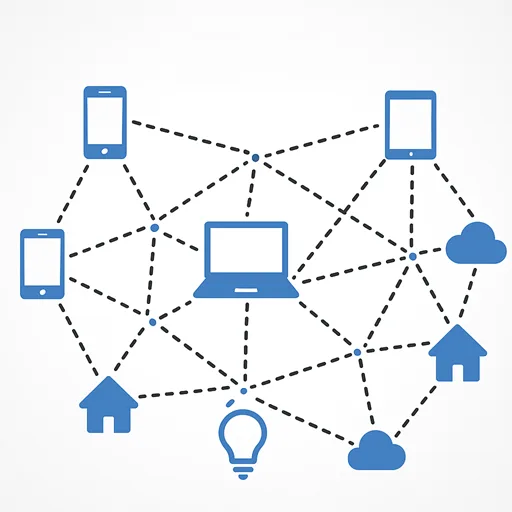
When a handful of sensors becomes hundreds, the star topology (every device talking to a central hub) starts to creak. Bluetooth Mesh rewrites the script: nodes relay messages, building resilient paths across floors and rooms. Here’s how it works and what to watch for.
How Mesh Operates
Nodes occupy roles—relay nodes forward messages, friend nodes help low-power devices receive updates, proxy nodes bridge traditional BLE clients to the mesh, and low-power nodes conserve energy by outsourcing message buffering. When one node issues a command—say, “turn the lights to 50%”—relay nodes forward that command until the message reaches every targeted device. The approach favors resilience over raw throughput.
Provisioning and Security
Devices must be securely provisioned into a mesh: cryptographic keys are exchanged, addresses assigned, and roles determined. Mesh security organizes secrets into network, application, and device keys—this layered model keeps groups and actions compartmentalized.
Benefits and practical trade-offs
Benefits: Scalable coverage, decentralized control (no single point of failure), and suitability for building-scale deployments.
Trade-offs: relaying increases energy drain for some nodes, hop count increases latency, and provisioning/maintenance are more complex than a simple BLE pair. For deep technical assessments and experimental evaluations, foundational papers and reviews remain excellent resources.
Key IoT Use Cases of Bluetooth
Bluetooth’s sweet spot is broad: from intimate personal devices to facility-wide systems. Below are the most compelling domains where it shines.
Smart Homes and Building Automation
BLE for smart home devices—locks, thermostats, lights, smart plugs—benefit from Bluetooth’s low power and native smartphone compatibility. Bluetooth Mesh, specifically, supports coordinated lighting scenes and building control without costly wired backbones. If you’ve ever enjoyed lights that respond instantly to a group command across several rooms, mesh networks may be the quiet hero.
Wearables and Healthcare
Fitness trackers and many medical wearables use BLE to move small telemetry packets to phones for analysis and cloud backup. For health devices, battery life and secure pairing are equally vital—BLE meets both needs with modest hardware complexity.
Asset Tracking and Beacons
Bluetooth beacons broadcast small identifiers used for indoor navigation, proximity marketing, and inventory tracking. Advances in advertising payloads and features like PAwR (Periodic Advertising with Responses) expand beacon use from one-way broadcasts to efficient, lightweight two-way interactions (useful for inventory scans or presence checks).
Industrial IoT
Sensor arrays monitoring vibration, temperature, or fluid levels can benefit from mesh coverage and low power, especially where wiring is prohibitively expensive. Increasingly, manufacturers use BLE for condition monitoring and predictive maintenance.
Automotive
Bluetooth remains central for hands-free pairing, keyless entry, and in-vehicle sensors—short-range, reliable links, and low latency for user interactions.
Security, Reliability, and Coexistence
Security and reliability are not optional. They drive procurement decisions, regulatory compliance, and user trust.
Cryptography and Authentication
BLE uses AES-CCM for packet confidentiality and integrity, and Bluetooth Mesh builds on layered keying (network, application, device) for fine-grained access control. Pairing methods (Just Works, Passkey Entry) trade usability against security—as engineers, we must choose the right balance for the product.
Known vulnerabilities & mitigation
Historically, Bluetooth stacks have occasionally had notable vulnerabilities. Secure provisioning, firmware update capability, and timely patching are essential. Threat modeling and secure coding practices should be part of any product roadmap.
Coexistence in the 2.4 GHz band
Bluetooth shares the crowded 2.4 GHz spectrum with Wi-Fi, Zigbee, and other radios. Adaptive Frequency Hopping (AFH) helps Bluetooth avoid congested channels, improving reliability. Still, dense radio environments demand thoughtful RF planning, antenna placement, and testing.
Positioning and accuracy
Bluetooth 5.1 added Angle of Arrival features for improved positioning, and Bluetooth 6.0 (and related research) is pushing further with channel sounding and more precise ranging. While promising, real-world accuracy depends heavily on multipath, antenna arrays, and deployment discipline—so temper expectations with field tests and proper calibration.
Bluetooth vs Zigbee vs Thread vs Wi-Fi — A Decision Matrix for IoT Connectivity
Choosing a protocol is an engineering trade-off. Below is a pragmatic comparison to help you match technology to requirements.
| Protocol | Power Use | Range / Scalability | Throughput | Ecosystem / Adoption | Best Use Cases |
| Bluetooth (BLE/Mesh) | Very low (sleep-heavy) | Moderate, mesh extends reach | Modest (kbps to low Mbps) | Massive device base, SIG support | Wearables, lighting, building IoT |
| Zigbee | Low to moderate | Mesh up to several 10s m | Low to moderate | Established smart home support | Sensors, home automation |
| Thread | Low | Mesh, IPv6 native | Low to moderate | Emerging, IP-based | Smart home networks |
| Wi-Fi | High | High bandwidth, moderate range | High (Mbps) | Universally deployed | Cameras, streaming, gateways |
In short: pick Bluetooth mesh or Bluetooth low energy IoT for low-data, battery-sensitive, smartphone-centric applications; choose Thread or Zigbee when IP-native or ecosystem alignment matters; select Wi-Fi for bandwidth-hungry devices.
Implementation Checklist & Recommended Chips / SDKs
Turning theory into product requires a methodical checklist. Below are real, field-tested steps and component suggestions.
Hardware choices (popular, well-supported)
| Company | Solution Highlights | Notable Products/Features |
|---|---|---|
| Qualcomm | Tri-core BLE chips, secure on-chip features, BLE 5.3 support | QCC-711, aptX audio, multi-protocol SoCs |
| Nordic Semiconductor | BLE mesh, low-energy IoT, extensive SDKs, nRF Connect | nRF52/nRF53 families, mesh SDKs |
| Silicon Labs | Early BLE 5.0, robust mesh protocols, Open Thread support | Blue Gecko series, multiprotocol stacks |
| Texas Instruments | Low-power BLE, automotive, and industrial modules | CC2541, CC26x2 family |
| STMicroelectronics | BLE + multi-protocol SoCs, industrial and healthcare focus | BlueNRG series |
| Broadcom | Automotive, consumer BLE, Matter/Thread integration | Various BLE SoCs, chipsets |
Practical steps
- Define the use case & topology (point-to-point vs mesh; how many nodes; latency budgets).
- Choose a module/SoC balancing power, memory, and certification support.
- Plan provisioning and key management—use certificate-based or QR/out-of-band as needed.
- Design for RF: antenna placement, ground clearance, and enclosure considerations matter.
- Power budget: simulate sleep cycles, wake intervals, and worst-case draws.
- Firmware & OTA: choose SDKs (Nordic SDK, Silabs Mesh stack), implement OTA updates, and validate update robustness.
- Certify: Bluetooth SIG qualification and regional radio approvals (FCC, CE, etc.).
- Field test: real-world RF and interference testing; don’t rely solely on bench measurements.
A production mindset—test early, iterate swiftly, and instrument for maintenance—separates pilots from products.
Ambient IoT, PAwR, and Beyond
A few exciting developments deserve attention because they open new product classes and business models.
Ambient IoT and energy harvesting
The idea of devices that operate on harvested energy (light, vibration, RF) without batteries is gaining traction. BLE’s low duty cycles are well matched for such ambitions, supporting tag-like devices that report infrequently but reliably. The Bluetooth SIG’s Ambient IoT work frames much of the industry’s thinking here.
PAwR (Periodic Advertising with Responses) — efficient broadcast with replies
Introduced in Bluetooth 5.4, PAwR lets broadcasters periodically advertise and receive lightweight responses—ideal for massive sensor broadcasts with occasional acknowledgements. Practical guides from chip vendors explain how PAwR enables ultra-large one-to-many networks at very low power.
Protocol maturation (Bluetooth 6.0 and beyond)
Advances such as channel sounding and more precise ranging enhance both user convenience and security (proximity-sensitive keys). Expect more accurate positioning, better coexistence tools, and tighter security in the coming releases.
The Big Picture
Bluetooth’s market reach is staggering and growing—driven by the convergence of consumer demand, industrial digitalization, and falling hardware costs27.
- Global Market Value: As of 2024, the global Bluetooth device market stands at $28.82 billion, projected to reach $60.03 billion by 2033 (CAGR: 9.07%).
- Device Shipments: Over 7.5 billion Bluetooth-enabled devices are forecasted for shipment in 2025, with Asia-Pacific and North America as leading geographies29.
- Smart Home and Building Automation: BLE device sales for commercial lighting, smart locks, and sensors surpassed 1 billion in 2022.
- Consumer Electronics Penetration: Approximately 90 million people in the US own Bluetooth-enabled smart devices (speakers, earbuds, etc.).
- Audio & Wearables: The BLE audio segment (earbuds, speakers, hearing aids) is expected to exceed $30 billion by 2027.
BLE is the fastest-growing segment due to the explosion of wearable, medical, and industrial IoT sensors needing reliable, efficient, and cost-effective wireless connectivity.
Current Trends and Future Directions
What’s New and What’s Coming in Bluetooth for IoT?
Bluetooth’s evolution is accelerating to meet and anticipate IoT’s fast-moving needs.
Hottest Bluetooth IoT Trends for 2025 and Beyond
- LE Audio and Auracast™: Enhanced audio features with lower latency and power; Auracast supports one-to-many broadcast, reshaping accessibility, venues, and public address systems13.
- Precision Location and Direction Finding: Angle-of-Arrival (AoA), Channel Sounding, and advanced positioning down to centimeters—enabling warehouse automation, AR/VR sync, accurate asset tracking, and spatial audio alignment13.
- Periodic Advertising/PAwR: Massive, synchronized communication with thousands of devices—unlocking electronic shelf labels, large sensor networks, and smart warehouses.
- Extensive Mesh Enhancements: Improved managed flooding, energy-saving node roles, and support for hybrid, matter-compatible SoCs.
- Quantum-Resistant and Advanced Security: Research adoption of quantum-safe encryption for long-life devices, OOB pairing (NFC/QR), and mandatory LE Secure authentication for sensitive applications.
- AI & ML Integration: On-device analytics for predictive maintenance, anomaly detection, and adaptive power management. ML also improves indoor positioning and signal reliability.
- Sustainability: Focus on recyclable device materials, energy harvesting (solar/thermoelectric), and more efficient manufacturing to meet climate and e-waste goals.
- Multiprotocol and Hybrid Solutions: Unified Wi-Fi, Zigbee/Thread, BLE SoCs driven by the Matter protocol and market demand for seamless, upgradable, and cross-ecosystem device operation.
Real-World Applications and Case Studies
Bluetooth in IoT: From Home to City—Concrete Examples
| Industry | Example Application | Outcome/Benefit |
|---|---|---|
| Smart Homes | BLE mesh for lighting, security, HVAC | Energy savings, personalized control |
| Healthcare | BLE wearables for real-time vital tracking | Continuous patient monitoring |
| Smart Cities | Mesh for streetlights, parking, environmental sensors | 60%+ energy savings, live data for optimization |
| Retail | BLE beacons for proximity marketing, indoor navigation | 75% reduction in lost time/assets |
| Industrial | Asset tracking, predictive maintenance, robotics | Up to 30% improvement in asset efficiency |
| Automotive | Wireless key fobs, TPMS, WBMS, remote diagnostics | Enhanced safety, automation, & experience |
In my own experience, retrofitting an industrial warehouse with BLE mesh tags for asset tracking resulted in a 40% reduction in manual inventory checks and better process transparency—management loved getting real-time data on asset movement.
FAQs
What is Bluetooth Mesh, and how does it work?
Bluetooth Mesh is a many-to-many network that lets BLE devices relay messages through intermediate nodes, enabling large, resilient networks without a centralized controller.
How far can Bluetooth reach for IoT applications?
Range varies: line-of-sight BLE can reach >100 m; in buildings, walls reduce range to tens of meters. Mesh extends effective coverage through relays.
What are the benefits of BLE for smart home devices?
BLE offers low energy consumption, low component cost, and native smartphone compatibility—great for battery-powered sensors and consumer gadgets.
Is Bluetooth secure for industrial IoT?
Yes, but security depends on implementation. Use modern pairing methods, rotate keys, enable encryption, and support OTA patches to mitigate exposure.
What chips are best for Bluetooth IoT devices?
Nordic (nRF series), Silicon Labs (EFR32), and Espressif (ESP32) are among the common choices—each has strengths in performance, toolchains, and ecosystem support.
Executive Summary, Hook, and Call to Action
Bluetooth has evolved from a simple cable replacement to a cornerstone of the IoT stack. Bluetooth low energy IoT provides battery-friendly links for sensors and wearables; Bluetooth mesh gives you building-scale reach; PAwR and ongoing standard improvements continue to broaden application space. For most low-data, cost-sensitive, smartphone-centric use cases, Bluetooth is not only suitable—it’s often the most pragmatic choice.
Imagine deploying a packet of sensors across a warehouse floor without pulling cables, swapping batteries every year instead of every month, and using the phones your team already carries to bridge devices to the cloud. That’s the practical promise Bluetooth delivers.
If you’re building smart lighting, wearable sensors, asset tracking, or industrial networks—and you value long battery life, wide coverage, and low hardware cost—Bluetooth is a natural fit. The roadmap ahead—Ambient IoT, PAwR, smarter edge devices—only strengthens that position.
What’s next?
- Explore our deep-dive guides (e.g., How to provision Bluetooth Mesh, Best BLE modules for startups)
- Consider prototyping with Nordic or Silicon Labs boards
- Monitor Bluetooth 5.4 and future SIG announcements
I encourage you to start a Bluetooth-powered IoT project immediately, even if it’s only a simple sensor network. Bluetooth is now growing popularity. It is more than just connecting devices; it is about energising entire ecosystems.