
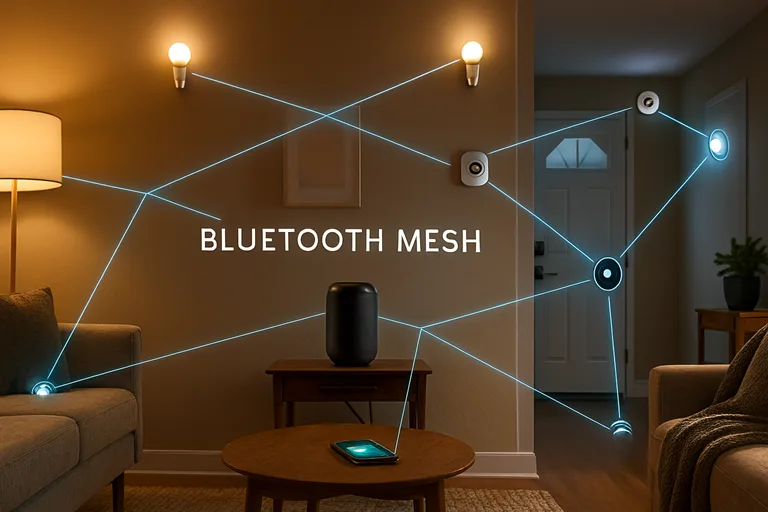
Consider walking into your house and saying a simple command, and instantly, everything in your home works together perfectly. The lights turn on, the curtains slide open, the speakers start playing your favorite music, and the thermostat adjusts the room temperature—without any wires, interruptions, or security problems.
You don’t have to wait for complex setup integration with the control center. There’s no waiting, no complicated setup, and no messy control centers. Every time it works flawlessly and automatically. Welcome to the age of Bluetooth Mesh—a technology quietly transforming how we control our smart homes.
Let’s explain what makes Bluetooth Mesh so unique, where it stands among competitors, how it works under the hood, and why it’s shaping up to be the protocol of choice for the smart homes of tomorrow.
- What Is Bluetooth Mesh? The Basics in Everyday Language
- How Is Bluetooth Mesh Different?
- Diving Deeper: How Bluetooth Mesh Is Engineered
- Real-World Smart Home Use Cases: What Can Bluetooth Mesh Do?
- Device Provisioning and Live Network Management
- Security and Privacy: Why Bluetooth Mesh Is Built for Peace of Mind
- Power Consumption and Battery Life Optimization
- Integration with Voice Assistants & Cloud Platforms
- Interoperability: Bluetooth Mesh, Matter, Thread, and the IoT Ecosystem
- Market Adoption: Who’s Betting Big on Bluetooth Mesh?
- Real-World Implementation Challenges (And Solutions)
- What’s Next? Upcoming Bluetooth Mesh Roadmap and Future Developments
- Bluetooth Mesh: Advantages & Drawbacks at a Glance
- FAQs
- Conclusion
What Is Bluetooth Mesh? The Basics in Everyday Language
Bluetooth Mesh takes the humble Bluetooth Low Energy (BLE) that powers your earbuds and fitness tracker and builds a self-organizing, many-to-many network on top of it. Unlike classic Bluetooth, which mostly connects one device to another (one-to-one or a few devices to one phone), Bluetooth Mesh allows thousands of devices to talk and relay messages throughout a whole home, office, or even a skyscraper.
But the magic comes not just from scale. Bluetooth Mesh is engineered for reliability, security, and energy efficiency—three things at the heart of making home automation truly work for real people.
If you’ve ever battled with unreliable smart bulbs, networks dropping your security sensors, or a hub that refuses a connection while you stand in your underwear at 2 am, you know the pain that Bluetooth Mesh sets out to fix.
How Is Bluetooth Mesh Different?
Bluetooth Mesh vs Other Smart Home Protocols
When shopping for smart home gear, the world of wireless protocols can feel like a raging sea—Zigbee, Z-Wave, Wi-Fi, Thread, Matter, and now Bluetooth Mesh. Let’s break down how Bluetooth Mesh stacks up against its main rivals.
| Feature / Protocol | Bluetooth Mesh | Zigbee 3.0 | Z-Wave | Wi-Fi | Thread | Matter |
|---|---|---|---|---|---|---|
| Topology | Mesh | Mesh | Mesh | Star (hub/router) | Mesh | Works over Thread, Wi-Fi, Ethernet |
| Max Nodes | ~32,000 | 65,000 | ~232 (old), 2,000+ new | 255 per router | 250+ | N/A |
| Range | 10-1000m (multi-hop) | 20-100m per hop | 30-100m per hop | 30m (indoor) | 100m+ (multi-hop) | N/A |
| Frequency | 2.4GHz | 2.4GHz | 908/915MHz | 2.4/5GHz | 2.4GHz | Varies |
| Power Use | Very low (LPN/Friend) | Low | Very low | High | Ultra low | Varies |
| Security | Mandatory, multi-layer | Mandatory | Mandatory | Varies by device | Mandatory | Very explicit |
| Latency | Low (for commands) | Low | Low | Varies | Very low | Low |
| Internet Protocol | No (but bridges exist) | No | No | Yes | Yes (IPv6) | Yes (app layer) |
| Smartphone Control | Native (most phones) | Needs hub | Needs hub | Direct (app) | Needs border router | Through platform |
| Ecosystem | Open, certified | Open | Proprietary | Open | Open | Open |
Bluetooth Mesh stands out for a few reasons:
- Device ubiquity: Most phones and tablets natively support Bluetooth.
- No dedicated hub/routing box needed for local-only control.
- Extreme scalability: Supports thousands of devices in one network (think commercial buildings or whole apartment complexes).
- Energy efficiency: Special roles allow battery-powered sensors to work for years with minimal charging.
- Strong security, out of the box: All traffic is encrypted and authenticated by default.
But it also has trade-offs:
- Lower bandwidth: Good for commands and sensor info, not video or audio.
- Setup can be more technical (though modern apps hide much of that complexity).
Diving Deeper: How Bluetooth Mesh Is Engineered
Network Architecture and Protocol Layers
Just look into the Bluetooth Mesh it takes the basic BLE “radio” and adds a robust, modular stack above it—each layer handling a crucial piece of the puzzle, from transmission up to application logic.
Architectural Layers:
- BLE Physical Layer: The actual radio broadcast (2.4GHz).
- Bearer Layer: Defines how messages go over the BLE airwaves—via advertising (“flooding” the area with packets) or GATT (to connect via a proxy or external controller).
- Network Layer: Handles message addressing, relaying, and security for all devices on the Mesh.
- Transport Layers (Upper/Lower): Segment large packets for transmission, add encryption and authentication, and handle retransmission reliability.
- Access Layer: Places messages in context of their function (e.g., lighting command versus configuration).
- Models/Foundation Layer: Standardized behaviors (like On/Off commands, sensors, scenes, schedules)—this is where interoperable smart home magic happens.
This stack means a light switch from Brand A, a motion sensor from Brand B, and a bulb from Brand C can all work together, as long as they conform to Mesh models.
Node types (with special roles):
- Relay Nodes: Receive and retransmit mesh messages, extending network range.
- Proxy Nodes: Gateway between BLE devices (like phones) and the Mesh.
- Low Power Nodes (LPN): Sleep most of the time to save energy—think battery sensors.
- Friend Nodes: Store messages for LPNs, delivering when the latter wake up.
This combination creates a self-healing, highly redundant network—take out a few nodes, and your system keeps humming.
Real-World Smart Home Use Cases: What Can Bluetooth Mesh Do?
Enough theory—let’s see some home magic in action:
- Whole-Home Lighting Control: Walk through every room, adjust every bulb, and create scenes (e.g., “movie night” dims the living room, brightens the kitchen, closes the blinds) all in perfect sync. Extend this to multi-story homes, backyards, or even a row of connected apartments.
- Occupancy-Based Automation: Motion sensors trigger hallway lights, smart thermostats, and music; everything turns off automatically when you leave. Friend/LPN combos mean even coin cell-powered sensors last for years.
- Security & Alerts: Entry sensors, sirens, panic buttons, and smoke detectors—all mesh together reliably, with instant notification through proxies to your phone or security hub.
- Energy Savings/Daylight Harvesting: Integration with daylight sensors dims or brightens lights, manages HVAC, and more, based on real-time conditions—lowering bills and carbon impact.
- Interconnected Everything: Door locks, blinds, smart plugs, appliances—Bluetooth Mesh isn’t just about lights; anything with BLE can be included.
- No-Hub Smartphone Control (Optional Cloud): Since phones and tablets can natively talk Bluetooth, you can control most mesh setups directly—no internet, no cloud delays, no privacy compromise.
Case in point: Commercial smart lighting companies (like Silvair, Signify/Philips, Osram, and MESHLE) as well as smart home platforms (e.g., Amazon Alexa, Tuya, Moes) are heavily investing in Bluetooth Mesh because it delivers these use cases with scale, resilience, and interoperability.
Device Provisioning and Live Network Management
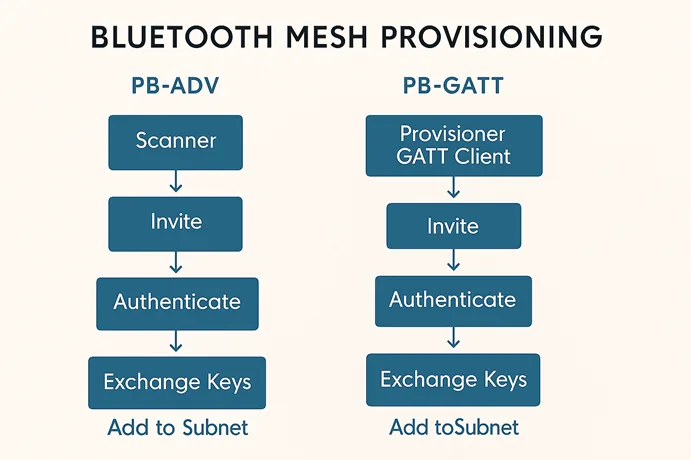
Before any device joins the Bluetooth Mesh party, it has to be provisioned—a rigorous process that supplies unique network keys and ensures only authorized hardware joins in.
The provisioning process consists of:
- Discovery/Beaconing: The new device announces its readiness (think of it as raising a hand).
- Invitation: A provisioner (typically an app on your phone or PC) starts the pairing process.
- Key Exchange: Uses Elliptic Curve Diffie-Hellman (ECDH) for secure, future-proof shared secrets.
- Authentication: User or app confirms the device is legitimate (could involve PINs, QR codes, or Out-of-Band data).
- Network Assignment: Keys and addresses are securely delivered, and the device becomes an official “node” on the Mesh.
From there, management is handled over the air—updating keys, adding or removing devices, grouping for scenes, and specifying publish/subscribe addresses.
Provisioning can be set up locally for privacy or remotely (via secure gateways) in bigger estate/pro setups.
Bonus: With the Bluetooth Mesh 1.1 spec, firmware updates for many devices can be delivered efficiently across the entire Mesh using the Device Firmware Update (DFU) model—a huge leap for long-term maintenance.
Security and Privacy: Why Bluetooth Mesh Is Built for Peace of Mind
Security isn’t a bolt-on afterthought in Bluetooth Mesh; it’s the default and mandatory—a major improvement over many older protocols.
Key highlights:
- Multi-layer encryption and authentication: Network, application, and device keys—all separate, all required.
- All traffic is encrypted: There’s no such thing as a “plain text” command in a Bluetooth Mesh network.
- Protection against replay attacks: Each message carries an incrementing sequence number; stale or copied messages are discarded.
- Mutually authenticated provisioning: Only trusted devices can join, using challenge-response schemes and Out-of-Band options for added security.
- Privacy enhancements: Addresses can be obfuscated to minimize device tracking, and newer specs allow for private beacons.
Common attack protections include:
- Man-in-the-middle attack defense: Via ECDH and OOB authentication.
- Key refresh and revocation: Keys can be updated or removed across the network if a device is compromised.
- Subnets and access control: Separate keys limit access areas and functions; for example, a guest could control only the guest suite’s lights.
- Managed flood relaying further reduces potential attack surface—there’s no central hub to take down.
The upshot: Bluetooth Mesh is safe enough for critical applications, both at home and in sensitive commercial spaces.
Power Consumption and Battery Life Optimization
“Low Energy” is right there in the name, but how does Bluetooth Mesh actually enable battery-powered sensors to last years?
The secret? Friend and Low Power Node (LPN) Relationships:
- LPNs (Sensors/Remotes): Spend most of their time asleep, with radios off, only waking to transmit data or check in for queued commands.
- Friend Nodes (e.g., always-on lights): Store messages from the Mesh addressed to their LPN partners, ready to deliver when the LPN wakes.
- Result: A coin cell-powered motion sensor or window contact can operate for 3-5 years on a single battery.
Compared to protocols requiring constant radio wake or more energy-hungry frequencies, Bluetooth Mesh brings enormous energy savings, especially for devices that rarely interact.
Integration with Voice Assistants & Cloud Platforms
You want to walk in and say, “Alexa, turn on my hallway lights”—and have it work, instantly and every time.
Bluetooth Mesh has native and rapidly growing support from leading smart assistants:
- Amazon Alexa: Most new Echo devices now feature BLE Mesh integration. They act as proxy nodes, bridging voice commands and cloud functions to the private mesh network.
- Google Assistant and Apple HomeKit: Via Bluetooth Mesh-friendly gateways—often built into smart speakers and home hubs holding multiple protocol radios.
- Matter Integration: (The new universal smart home standard) is increasingly built atop Thread and BLE Mesh, with bridges and gateways translating between legacy and contemporary protocols, allowing Alexa, Google, Siri, and platform apps to control all mesh devices.
Direct smartphone/tablet control is also possible via mesh proxy nodes—so even without internet or an assistant, you can run your home with an app (and provision new devices at will).
Interoperability: Bluetooth Mesh, Matter, Thread, and the IoT Ecosystem
Remember the protocol confusion mentioned earlier? Matter—the much-hyped standard from Apple, Amazon, Google, and CSA—is bringing a new peace treaty to smart homes.
Bluetooth Mesh and Thread both enable mesh networking:
- Bluetooth Mesh: Leverages the massive installed base of BLE radios in phones, tablets, and PCs—open, widely certified, and perfect for lighting, sensors, and automation grids.
- Thread: IP-based Mesh (runs over IPv6), designed for direct cloud connectivity and easy transitions to Wi-Fi or Ethernet. The thread is tightly bundled with Matter.
- Matter: Provides a common language at the app layer; it rides on Thread or Wi-Fi (or bridges from Zigbee/Bluetooth Mesh).
Gateways/Bridges: Leading hardware now often supports multiple protocols (Zigbee, Z-Wave, Thread, BLE Mesh, Wi-Fi), translating as needed. The result is real-world interoperability—a light using Bluetooth Mesh can, through a gateway or Matter bridge, respond to a command from a Thread or Zigbee remote. This is crucial for future-proofing smart homes.
Market Adoption: Who’s Betting Big on Bluetooth Mesh?
Over the past three years, Bluetooth Mesh has moved from “interesting” to mainstream in the professional lighting and home automation markets.
Signs of surging momentum:
- Commercial Lighting: Silvair, Signify/Philips, Osram, MESHLE, and others are deploying city-scale projects.
- OEM Platforms: Major chipmakers (Nordic Semiconductor, Silicon Labs, Cypress/Infineon, STMicro, TI, Espressif) shipping Mesh-ready chipsets and modules.
- Smart Home Brands: Xiaomi, Moes, Tuya, Dusun, Yourlite, Lansitec, Rigado—all fielding Mesh-powered products for home, security, sensors, and automation.
- Voice Assistants: Latest Echos, Google Hubs, SmartThings, and Apple Home devices that support mesh networks.
Market Data:
- The Bluetooth Mesh market was worth $1.24 billion in 2024, and is expected to grow to more than $3.7 billion by 2033, with a compound annual growth rate of around 15%.
- Over 200 million Bluetooth Mesh devices were shipped for industrial and IoT applications in 2025 alone.
Turnkey Smart Home Ecosystems: Tuya, Moes, Xiaomi, and others now let you install, control, and scale up your automation entirely via Bluetooth Mesh, sometimes with Matter compatibility built in.
Real-World Implementation Challenges (And Solutions)
No technology is perfect. Bluetooth Mesh’s decentralized, highly secure approach comes with some tradeoffs and learning curves:
Historical Friction Points:
- Complex initial provisioning: Early setups required more technical know-how, but improved apps now mask much of the process.
- Low throughput: Mesh is optimized for control/command and sensor data—not for streaming audio or video.
- Managed flooding overhead: Creates network “chatter” that can constrain battery life on relay nodes if not tuned, especially in very dense deployments.
- Firmware update distribution: Getting updates out to all nodes at once was challenging, but the Mesh DFU model and BLOB transfer (1.1 spec) now streamlines this.
- Interoperability: Devices from different vendors sometimes had hiccups unless they strictly adhered to the Mesh model specs. Ongoing certification and adoption of Mesh Model 1.1/1.0.1 profiles are closing these gaps.
Best Practices Emerging:
- Use sufficient always-on relay/friend nodes to support LPNs.
- Segment networks for very large buildings or complexes using subnets and subnet bridges.
- Use gateways with Matter integration for cloud, voice, and multi-protocol control.
- Automate key refreshes and updates for long-term security.
What About Consumer Behavior?
- Consumers want: Plug-and-play, no single point of failure, instant voice/app control, energy savings, and privacy local-first.
- Bluetooth Mesh checks these boxes—and once users experience the “it just works” effect, loyalty follows.
What’s Next? Upcoming Bluetooth Mesh Roadmap and Future Developments
The pace of innovation is only accelerating. Here’s a glimpse of the road ahead for Bluetooth Mesh:
- Bluetooth Mesh 1.1+: Acquires efficient directed forwarding (less “chatter”/overhead), remote provisioning (add devices from anywhere), and bulk BLOB transfers for firmware updates.
- Greater Matter and Thread bridges: Mesh and IP-based protocols will coexist via border routers and gateways.
- Native support in major platforms/voice assistants: Echo, Google Home, and others will make Mesh a first-class citizen.
- Better energy modeling and battery improvements: Expect new LPN profiles for ultra-long sensor life.
- Increased smart city, medtech, and industrial adoption: From hospital asset tracking to public lighting, Mesh scales anywhere.
- Edge AI and contextual automation: Mesh nodes feeding local data to AI models for in-room, privacy-preserving automation.
Bluetooth Mesh: Advantages & Drawbacks at a Glance
| Smartphone support for Mesh is currently via proxy | Drawbacks |
|---|---|
| Open, certified ecosystem | More complex network setup than “hub” systems |
| No single point of failure | Not optimized for heavy data (audio/video) |
| Provable security | Needs enough relay or friend nodes for large spaces |
| Self-healing, redundant | Complexity can hinder small consumer deployments |
| Extreme scalability | Managed flooding can impact the relay battery life |
| Long battery life via Friend/LPN | Managed flooding can impact relay battery life |
| Interoperable, future-proof | Still catching up on Matter/Thread seamlessness |
| No hub required for local op | Certification and models evolving for consistency |
| Local-only control supported |
Bottom line:
Bluetooth Mesh is best in use cases demanding scale, reliability, energy savings, and security. Perfect for lighting, sensors, and automation—less so for bandwidth-heavy AV. As it matures, with new spec improvements and Matter integration, drawbacks are becoming less of a concern.
FAQs
Conclusion
The landscape of smart home control has changed—gone are the days when you relied on a clunky hub, prayed the Wi-Fi wouldn’t drop, or cursed the lack of interoperability. Bluetooth Mesh has quietly become the backbone powering the living spaces of tomorrow: robust, secure, scalable, and increasingly frictionless.
So, whether you’re a smart home enthusiast tired of fixing your old system, a homeowner ready to upgrade, or a property manager tasked with future-proofing entire buildings, the time to go Bluetooth Mesh is now.
Why settle for tech that’s stuck in the past, when the future is Mesh?
Ready to step into real smart home control?
Explore certified Bluetooth Mesh devices from trusted brands like Xiaomi, Silvair, MESHLE, Tuya, Moes, and more, or ask your installer for mesh-ready lighting and sensors.
Prefer DIY? Check out user-friendly apps and get started with retrofit bulbs and switches today.
Welcome to the seamless, secure, and smart home you actually deserve. Go Mesh—because your home should be as smart as you are.
Not sure where to start?
Read more about Bluetooth Mesh technology here.
Explore certified Mesh products.
Because in a truly “smart” home, you don’t think about the wires, the protocols, or the setup…
You live.”

Your point of view caught my eye and was very interesting. Thanks. I have a question for you.
Thanks so much for reading and for the kind words! I’m really glad the perspective resonated with you. If you have any specific questions or something you’d like a deeper explanation on, feel free to ask—I’m always happy to help clarify or expand on anything in the article.