
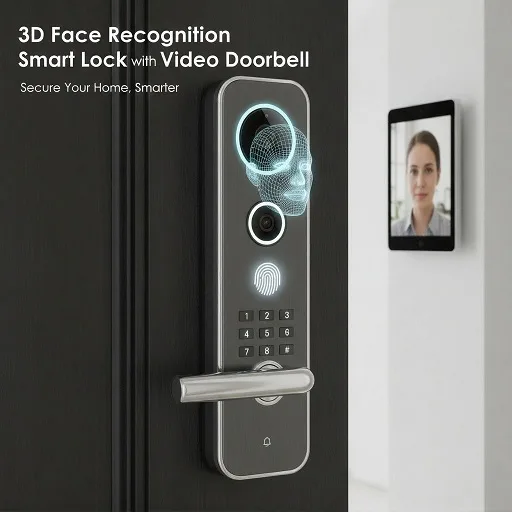
The concept of a keyless entry smart lock is no longer novel, but the integration of a verified 3D face recognition smart lock with video doorbell capability represents a crucial turning point in residential security. It’s the ultimate convergence of two primary consumer desires: uncompromised protection and frictionless convenience. We’re not just talking about unlocking a door with your face; we’re talking about an access system that handles authorization, surveillance, and two-way communication, all through a single, sophisticated mechanism at your front door.
The modern homeowner or small business proprietor demands technology that simplifies life without introducing new points of vulnerability. When considering the stakes—the safety of your family and property—a high-end biometric smart lock anti-spoofing solution is arguably the most crucial component of a connected home.
The Non-Negotiable Technology: Why 3D Face ID is Critical Security
Let’s face it: for a product designed to protect your home, there is absolutely no room for error. The difference between a cheap smart lock and a trusted, high-end system often boils down to a single dimension: depth. This is why the term 3D face recognition smart lock is not a mere marketing phrase; it’s a security mandate.
The Fundamental Flaw of 2D Facial Recognition
In your search for a facial recognition smart lock, you will inevitably encounter cheaper models that utilize 2D smart locks. On the surface, they seem capable—they recognize a face. However, these systems rely solely on a flat, two-dimensional image, much like a smartphone camera.
That’s a major vulnerability.
Security experts widely agree that relying on a 2D system introduces an unacceptable security risk, as common spoofing attacks easily fool these devices. Think about it: a high-resolution photograph, a video played on a smartphone screen, or even a simple mask can often bypass a basic 2D scanner. When the objective is to protect your smart home perimeter, you must eliminate any chance of a simple trick compromising the entryway. This vulnerability is precisely why many 3D face ID door lock manufacturers use strong language to advocate for the security of their advanced solutions.
Depth, Detail, and Defense: The 3D Advantage
A true 3D face recognition smart lock overcomes this fundamental weakness by incorporating infrared or near-infrared cameras and depth-sensing technology. These advanced sensors analyze facial structure across three dimensions—width, height, and, most importantly, depth.
This technological leap provides three critical benefits that establish genuine Expertise in the security field:
- Superior Anti-Spoofing: The depth map generated by the sensor is the core defense against fraudulent entry. The lock isn’t just looking for a pattern; it’s confirming the physical presence of a three-dimensional, living face. This sophisticated liveness detection makes the system virtually immune to photos, videos, and sophisticated silicone masks.
- Environmental Resilience: Unlike 2D systems that may struggle in shadow or blinding daylight, 3D technology’s use of dedicated infrared depth sensing allows the lock to function reliably in extreme light conditions, including at night. After all, the security system must be at its most reliable when threats are typically highest—after dark.
- Speed and Intuition: Because the system is reading depth, the recognition is incredibly fast. Most high-end 3D face ID models can identify and unlock the door in under one second. This allows for fully contactless entry, that is, quite frankly, “faster and more intuitive” than fumbling with fingerprints or codes, especially when you arrive home with arms full of groceries or packages.
To clarify the necessary technological investment, consider this comparison table, which highlights why 3D face recognition is the only reliable choice for modern access control:
| Feature | 3D Facial Recognition | 2D Facial Recognition | Fingerprint/Palm Scan | Keypad/Key |
|---|---|---|---|---|
| Anti-Spoofing Security | High (Depth analysis, Liveness detection) [1] | Low (Vulnerable to photos/videos) | Very High (Requires biological interaction) | Moderate (Requires key/code security) |
| Performance in Low Light | Excellent (Dedicated sensors, Infrared) [1, 2] | Poor (Relies on ambient/standard lighting) | Excellent | Excellent |
| Contactless Entry | Yes [3] | Yes | No (Direct contact required) | No (Physical input required) |
| Speed/Intuition | Fastest, Highly intuitive [3] | Fast (If conditions are optimal) | Moderate | Slow/Moderate |
The Best Smart Locks with Video Doorbell
The decision to combine the lock and the camera is brilliant. Why manage two separate devices—a smart lock for access and a video doorbell for surveillance—when you can have a powerful, unified system?
The market’s top-tier solutions are those that have successfully merged these two functions into a seamless security workflow.
The Top Tier Contenders: Critical Evaluation
When evaluating the market for an integrated smart lock with video doorbell, two product lines frequently define the competition, even as new Tuya and Locstar solutions emerge :
- Lockly Visage Zeno Series: This line is frequently recognized by technology reviewers as the “Best for Facial Recognition“. Specifically, the Lockly Vision Zeno Series Video Smart Lock includes an integrated video camera and intercom capability. These systems use 3D depth sensing for high accuracy and offer robust features like fingerprint scanning and the mechanical key override.
- Lockin Veno Pro: This model sets the functional benchmark for the combined form factor, earning recognition as the “Best Lock and Video Doorbell Combination“. While it utilizes advanced Palm Vein Recognition instead of 3D Face ID, its extensive feature set—including a built-in 2K video doorbell and local onboard video storage—establishes the bar for integration, compatibility, and high-security access redundancy.
The key takeaway here is the focus on multimodal biometrics. Having the option of a secondary biometric method, such as a high-quality fingerprint sensor or palm vein scanner, ensures that access is never compromised. If the primary 3D face recognition sensor is obscured by bad weather or an operational error, your entry is still instantaneous and secure.
Multimodal Access and Redundancy
A sophisticated 3D face recognition smart lock should provide a minimum of five unlocking methods to ensure you are never locked out of your home, regardless of the situation:
- 3D Facial Recognition: The primary, most convenient mode.
- Secondary Biometric: Fingerprint or Palm Vein scanning for reliability.
- Touch Keypad Passcode: For guests or in case of an app failure.
- Smartphone APP Control: Remote access and real-time monitoring.
- Mechanical Key Override: The ultimate fail-safe. This physical keyless entry smart lock backup is non-negotiable and provides guaranteed access during power failure or electronic malfunction.
Look for solutions offering Direct Wi-Fi capability. This allows the lock to connect directly to your home network, bypassing the need for a separate, often proprietary, bridge device. Simplifying the connectivity hardware removes a potential point of failure and improves the reliability and low-latency of the lock’s remote functions.
The Doorbell Component: Surveillance-Grade Visibility
The “video doorbell” part of this equation cannot be an afterthought. This camera is your virtual eyes at the doorstep, responsible for surveillance-grade visibility and control. When comparing models, look beyond simple marketing claims about the camera and focus on tangible metrics:
- Camera Resolution: Is it true HD or even 2K footage? Clarity is essential for identifying package thieves or verifying an identity from a distance.
- Field of View (FoV): Does the camera capture a wide enough angle to see packages placed directly in front of the door or people approaching from the side?
- Response Time: How quickly does the camera begin recording and send you a notification when it detects motion or an unrecognized face? The integrated system should trigger video recording and notifications instantaneously, allowing you to engage in two-way audio communication immediately.
The power of the smart lock with video doorbell is realized when these two technologies work together. Suppose the 3D face ID system fails to recognize a person. In that case, the camera immediately provides visual context, allowing you to determine if the person is a delivery driver or a stranger, and react accordingly.
The Trust Equation: Data Architecture, Privacy, and Mediation
Consumers purchasing smart home security devices are caught in a paradox: the fear of burglary drives them to buy the device, but privacy concerns can negatively impact their attitude toward the purchase. A superior product must mediate this conflict perfectly.
Confronting the Fear vs. Privacy Paradox
You are turning your face into a digital key, and that key is arguably the most sensitive piece of personal information you possess. Every time you use the lock, data is being collected—your biometric template, video footage, and access logs. The consumer must have verifiable trust in how that data is handled.
A great smart lock manufacturer understands that security is only as strong as its weakest link, and often, that link is the security of your private data on a third-party server.
Where Does the Biometric Data Live? Local vs. Cloud Processing
This is the single most important question when choosing a facial recognition smart lock. When a device processes and stores your biometric template in the cloud, that information travels to external company servers worldwide.
A privacy-first approach demands local data storage. Locks like the Lockly Visage Zeno Series (Vision) store data—such as fingerprint templates and facial data—locally on an encrypted microchip right inside the lock.
Why is this so vital?
- Enhanced Security: Localized storage confines any potential data breach to a single lock unit, preventing the catastrophic compromise of entire account databases.
- Increased Speed and Reliability: Since the lock isn’t waiting for the cloud to authenticate, the unlocking speed is drastically faster—often 0.3 seconds every time, compared to the 2 to 5 seconds typical of cloud-dependent locks. Furthermore, if your home internet goes down, your security system remains fully operational, and you are not locked out.
Encryption, Authentication, and The Future of Fraud Prevention
Beyond where the data is stored, how it is protected matters immensely. High-end systems must integrate Multi-Factor Authentication (MFA) for accessing the lock’s companion app. This means combining biometrics with another layer of protection, greatly limiting the risk of unauthorized remote access.
The best biometric smart lock anti-spoofing systems are also designed to be future-proof. They utilize advanced cryptographic algorithms and must be capable of receiving Over-the-Air (OTA) firmware updates. This capability allows the manufacturer to push new liveness detection technologies to counter emerging fraud methods, ensuring your investment remains protected against increasingly sophisticated threats like deep-fake videos or advanced masks.
Balancing Security Benefits with Data Privacy Concerns
| Security Benefit | Privacy Risk | Mitigation Strategy |
|---|---|---|
| Strong anti-burglary deterrence (Fear) | Storage of sensitive biometric templates | Mandate local (on-device) processing; insist on high-grade encryption for any necessary cloud sync. |
| Hands-free, rapid access for family (Convenience) | Potential for data breaches/hacking | Multi-layer encryption; mandated Multi-Factor Authentication (MFA) for app access. |
| Real-time threat identification (video) | Unintended passive data collection (neighbors, delivery people) | Strict, user-defined data retention policies; ensure video footage privacy controls are available. |
Real-time threat identification (video) Unintended passive data collection (neighbors, delivery people), Strict, user-defined data retention policies; ensure video footage privacy controls are available.
Installation, Ownership, and Longevity
The most advanced technology in the world is useless if it’s poorly installed or constantly running out of battery. Real-world Experience dictates that the long-term satisfaction with your 3D face recognition smart lock hinges on practical, maintenance-level details.
DIY Feasibility and Door Compatibility
Many manufacturers promote their locks as offering simple 15-minute DIY installation. While this can be true, achieving optimal function requires meticulous attention to detail. Smart locks are sensitive devices; even slight resistance can impede the motor, reducing battery life and performance.
When installing a sophisticated keyless entry smart lock, it is paramount to ensure the deadbolt is fully extended and the torque blade is correctly installed and perfectly vertical. If the lock feels “sticky” or the motor strains, the installation needs adjustment.
Furthermore, always check door compatibility—premium models are generally designed to fit standard door thicknesses and materials, including a wooden door or steel door.
Power Management: Overcoming the High-Consumption Challenge
A major hurdle for these all-in-one hybrid devices is power consumption, particularly from the active 3D face recognition and Wi-Fi modules. Today’s systems have improved dramatically, often featuring large internal batteries (e.g., 4200mAh) or supporting high-energy alkaline batteries capable of lasting up to one year.
However, the user experience can be compromised by poor management. Be acutely aware of the following:
- Wi-Fi Signal Quality: A weak Wi-Fi signal at your door forces the lock’s module to use higher power levels, drastically accelerating battery drain. Investing in a Wi-Fi range extender near the door can directly improve the longevity of your lock’s battery life.
- Low-Power Mode: When the battery voltage drops significantly (for instance, to 20% capacity or less), many locks enter a low-power mode. Crucially, this mode often disables high-draw features, including 3D facial recognition, to conserve the remaining charge. This means the very feature you paid a premium for is the first to be sacrificed when maintenance is neglected. A reliable low-battery alert and a functional emergency USB external 5V power supply port are essential backups.
Environmental Resilience and Durability
Your 3D face recognition smart lock with video doorbell is exposed to the elements 24/7. Longevity is determined by its Ingress Protection (IP) rating. For external applications where the lock may be subjected to rain, dust, or snow, you must insist on a weather resistance rating of at least IP65 weatherproof.
This rating signifies that the lock is protected against low-pressure jets of water from any direction, ensuring its sensitive electronics and lenses remain functional despite the local climate. A lock with excellent biometrics but a poor IP rating is simply a guaranteed failure waiting to happen.
Frequently Asked Questions (FAQ)
What is the difference between 3D face recognition vs 2D face recognition smart lock?
The fundamental difference is security. 3D face recognition smart locks analyze depth, width, and height, making them highly resistant to spoofing attempts using photos, videos, or masks. 2D smart locks only analyze a flat image and are easily tricked, making them an unreliable choice for primary home security.
Is my biometric data stored locally or in the cloud on these high-end locks?
Leading manufacturers of 3D face ID door locks and biometric smart locks often use a hybrid approach, but the most secure models prioritize local data storage. This means your biometric template (the mathematical map of your face) is stored on an encrypted microchip within the lock itself, never leaving your home. This prevents mass data breaches and ensures faster, more reliable access, even if your Wi-Fi fails.
Does a 3D face recognition smart lock work in total darkness or low light?
Yes, reputable 3D face recognition smart locks are equipped with specialized infrared depth sensing technology. Unlike older systems that require ambient light, these sensors can accurately map the face and grant access even in total darkness.
Which smart home protocols are typically supported by the best integrated locks?
The best smart lock with video doorbell solutions supports multiple integration protocols. While many work with Alexa compatible smart locks and Google Home ecosystems, premium, future-forward models are also beginning to include support for Matter and Thread protocols, ensuring seamless, low-latency integration across various smart home brands.
Do I still need a mechanical key override for a sophisticated keyless entry smart lock?
Absolutely. A mechanical key override is essential for privacy and safety. In the rare event of a complete system malfunction or total battery depletion, the physical key ensures you retain guaranteed access to your home. Always check that your chosen model includes physical backup keys.
Conclusion
The convergence of the 3D face recognition smart lock with video doorbell is not just an upgrade; it’s the establishment of a new standard for residential access control.
This sophisticated smart lock with video doorbell system provides redundancy, speed, and real-time surveillance, moving you away from the friction of fumbling keys or unreliable two-dimensional tech. You’re not just buying a lock; you’re investing in the peace of mind that comes from knowing your home’s perimeter is protected by financial-grade, future-proof biometrics.
Don’t settle for vulnerability. Make the smart upgrade today and step into a new era of frictionless security. Choose a trusted 3D face ID door lock that provides both the video evidence and the access control your family deserves.

Your point of view caught my eye and was very interesting. Thanks. I have a question for you. https://accounts.binance.com/lv/register?ref=SMUBFN5I
Thank you, that really means a lot! I’m glad the perspective resonated with you.
I’m always happy to help — what’s your question?